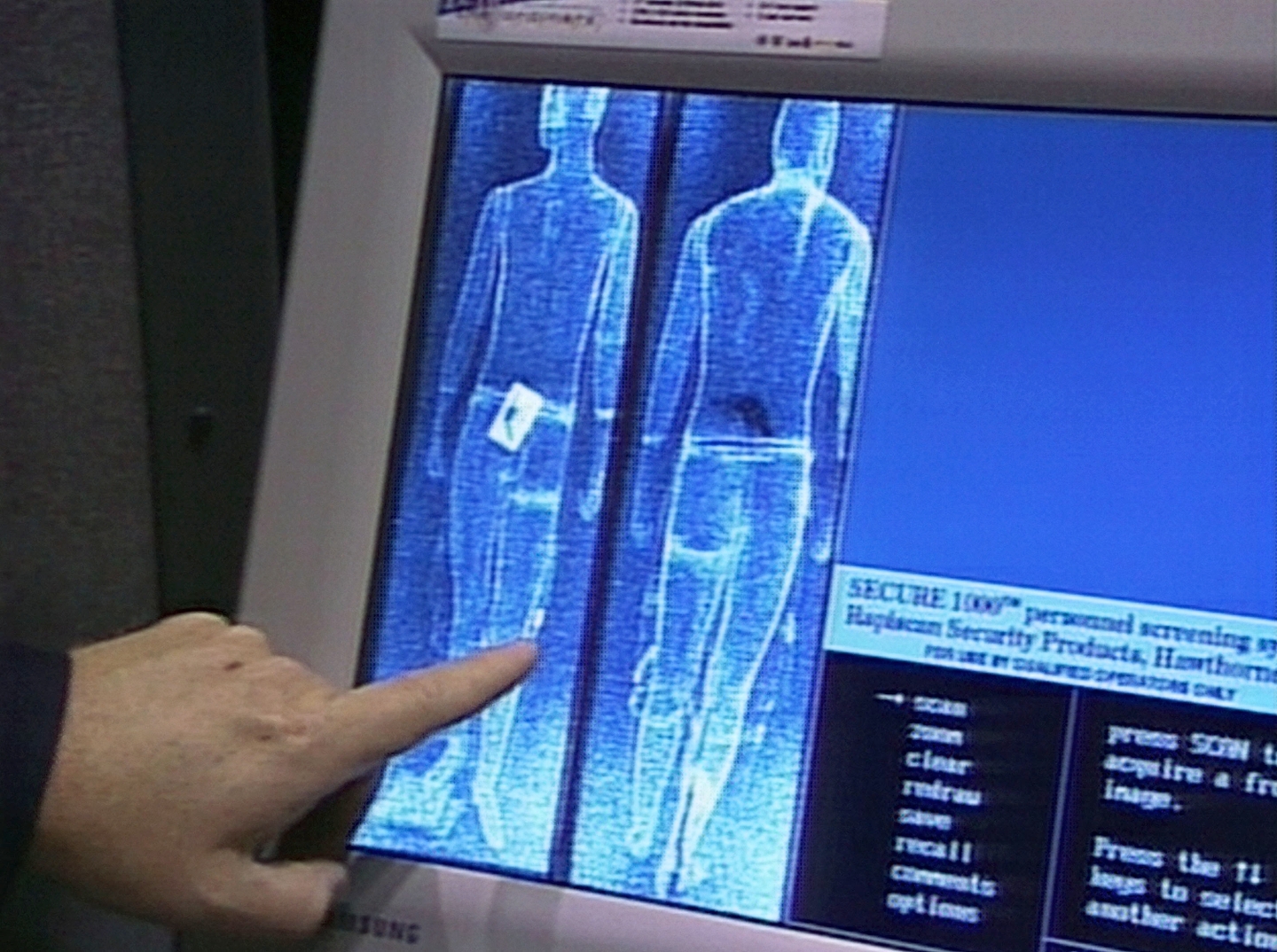
The old airport body scanners were once widely criticized as “virtual strip searches,” a label that captured public unease more than technical nuance—but not without reason.
Anyone who has passed through airport security knows the uneasy pause that comes with stepping into a scanner, arms raised, instructions barked through glass. Today the discomfort is mostly psychological. In the early 2010s, however, it was far more literal. For a brief period, some passengers were unknowingly subjected to imaging technology that revealed far more than most people believed acceptable.
Following the 2009 Christmas Day bombing attempt, the Transportation Security Administration accelerated the deployment of advanced body scanners as part of a broader push to close security gaps. Among them were backscatter X-ray machines manufactured by Rapiscan. These scanners were rolled out across major U.S. airports with the stated aim of improving safety—but they quickly became a flashpoint.
The images produced by early backscatter scanners displayed detailed outlines of passengers’ bodies. While officials emphasized that the images were viewed by officers in separate rooms and not stored, many travelers and privacy advocates argued that the level of detail was excessive and invasive. Trust eroded quickly once the public learned what the technology actually revealed.
Critics dubbed the process a “virtual strip search,” not as a rhetorical flourish, but as an expression of a deeper concern: how much personal privacy should be surrendered in the name of security. Online reactions ranged from frustration to disbelief, with many questioning whether the scanners provided real protection or merely the appearance of control.
By the numbers, the program was significant. Each scanner reportedly cost around $180,000, and by the time concerns peaked, more than 170 units had been installed at dozens of airports nationwide. Yet the controversy proved decisive. In 2013, the TSA removed the backscatter scanners after they failed to comply with updated privacy requirements mandating the use of Automated Target Recognition software.
ATR technology replaced detailed body images with generic outlines, highlighting potential threats without displaying a person’s unique physical features. When Rapiscan could not adapt its machines to meet this standard, the scanners were withdrawn.
They were replaced by millimeter-wave scanners, which remain in use today. Unlike earlier systems, these scanners rely on abstract imaging and advanced sensors, flagging areas of concern without exposing anatomy.
As researcher and author Shawna Malvini Redden explained in an interview with Reader’s Digest, early versions of the technology were deployed without sufficient privacy protections. Today’s systems, by contrast, are designed to separate threat detection from personal exposure.
For many travelers, learning about the early scanners years later has been jarring. The episode serves as a reminder that technological capability often advances faster than ethical consensus—and that public oversight matters.
From a deeper lens, the story is not merely about scanners, but about boundaries. Security is essential, but so is restraint. When fear accelerates decision-making, safeguards must be strengthened rather than suspended. Progress, when it is genuine, learns from its overreach.
The machines are gone. The lesson remains: privacy, once compromised, is difficult to restore—and vigilance is required not only against threats, but against the quiet normalization of intrusion.
{"post":46748,"page":1,"next":[{"id":46722,"url":"https:\/\/dailypositive24.com\/46722","title":"Disabled Man Dies Weeks After His Primary Caregiver Father Is Detained By ICE","image":"https:\/\/dailypositive24.com\/wp-content\/uploads\/2026\/01\/625774554_1459835342173310_7699245024896342512_n-768x960.jpg"},{"id":46689,"url":"https:\/\/dailypositive24.com\/46689","title":"Harrowing final words of man who died \u2018worst death ever\u2019","image":"https:\/\/dailypositive24.com\/wp-content\/uploads\/2026\/01\/HE-664x350-1.jpg"},{"id":46718,"url":"https:\/\/dailypositive24.com\/46718","title":"Breaking: Global Situation Escalates as Nations Move to High Alert","image":"https:\/\/dailypositive24.com\/wp-content\/uploads\/2026\/01\/623967546_122195281262529313_932131593162685010_n-768x576.jpg"},{"id":46715,"url":"https:\/\/dailypositive24.com\/46715","title":"Turn a Pool Noodle into a Beautiful Glowing Backyard Decoration","image":"https:\/\/dailypositive24.com\/wp-content\/uploads\/2026\/01\/624478235_122195321828529313_6372307546394713916_n.jpg"},{"id":46712,"url":"https:\/\/dailypositive24.com\/46712","title":"He Didn\u2019t Come Alone to His Wife\u2019s Farewell \u2014 Her Final Message Changed Everything","image":"https:\/\/dailypositive24.com\/wp-content\/uploads\/2026\/01\/625014807_122195354546529313_8929352207877741978_n-768x922.jpg"},{"id":46708,"url":"https:\/\/dailypositive24.com\/46708","title":"Man Who Attacked Rep. Omar Identified \u2014 Background Reveals Alarming Details","image":"https:\/\/dailypositive24.com\/wp-content\/uploads\/2026\/01\/624737120_122168634230770521_4804020396961518780_n-768x964.jpg"},{"id":46705,"url":"https:\/\/dailypositive24.com\/46705","title":"Pharmacist Issues Warning to Anyone Who Takes Vitamin D: Critical Safety Advice on Dosage Limits, Hidden Interactions, Absorption Factors, Supplement Quality, Toxicity Risks, Daily Requirements, Testing Needs, Seasonal Use, Medical Conditions, Common Myths, Label Confusion, Overuse Dangers, Professional Guidance, and How to Supplement Wisely Without Harming Long-Term Health Outcomes Balance","image":"https:\/\/dailypositive24.com\/wp-content\/uploads\/2026\/01\/hgrtrth.jpg"},{"id":46702,"url":"https:\/\/dailypositive24.com\/46702","title":"Catherine O\u2019Hara, Beloved \u2018Schitt\u2019s Creek\u2019 and \u2018Home Alone\u2019 Star, Passes Away at 71","image":"https:\/\/dailypositive24.com\/wp-content\/uploads\/2026\/01\/623365807_122309591564011573_8252276674517590324_n-768x959.jpg"},{"id":46697,"url":"https:\/\/dailypositive24.com\/46697","title":"Macaulay Culkin shares emotional tribute after Home Alone star Catherine O\u2019Hara dies aged 71","image":"https:\/\/dailypositive24.com\/wp-content\/uploads\/2026\/01\/625364128_122285351906027953_8239831943621604262_n.jpg"},{"id":46694,"url":"https:\/\/dailypositive24.com\/46694","title":"Remembering Two Lifelong Friends from Texas Who Passed Away Under Similar Circumstances","image":"https:\/\/dailypositive24.com\/wp-content\/uploads\/2026\/01\/624263113_122309630510011573_9140429273085010170_n-768x960.jpg"},{"id":46691,"url":"https:\/\/dailypositive24.com\/46691","title":"Men Who Skip This Routine Habit Face 45% Higher Risk Of Prostate Cancer","image":"https:\/\/dailypositive24.com\/wp-content\/uploads\/2026\/01\/622407979_1458293572327487_6971239229568332863_n-768x960.jpg"},{"id":46685,"url":"https:\/\/dailypositive24.com\/46685","title":"My Stepmom Smashed My Late Mom\u0027s Family Dishes After I Refused to Give Her My Mom\u0027s Engagement Ring \u2013 Karma Didn\u0027t Miss","image":"https:\/\/dailypositive24.com\/wp-content\/uploads\/2026\/01\/m_26a20af2-be5e-4b87-84f7-86249d392deb.webp"},{"id":46681,"url":"https:\/\/dailypositive24.com\/46681","title":"I Adopted a 3-Year-Old Girl After a Fatal Crash \u2013 13 Years Later, My Girlfriend Showed Me What My Daughter Was \u0027Hiding\u0027","image":"https:\/\/dailypositive24.com\/wp-content\/uploads\/2026\/01\/1a87a2e86fcf15bdcdb08714a3e3ab26dd8a1648d900ed5310dd4a37b4bb6bc1-768x384.jpg"},{"id":46677,"url":"https:\/\/dailypositive24.com\/46677","title":"Women reveal how long they would actually like sex to last","image":"https:\/\/dailypositive24.com\/wp-content\/uploads\/2026\/01\/bed-664x350-1.jpg"}]}
 Sad news: David Muir
 When the Border Went Quiet
 Former CNN anchor Don Lemon arrested by federal agents!
 I Spent Weeks Preparing a Surprise Party for My Husband but He Walked in Holding Another Woman's Hand – So I Took the One Thing He Valued Most
 I Met A Guy From Another Country Online And Decided To Test His Promises, But His Surprising Response Led Me To A Truth I Never Expected
 My Husband's Mistress Accidentally Sent Me Her Photo in My Robe – I Was Broken, But a Revenge Plan Started Forming in My Mind