Can You Spot All the Hidden Animals in These Optical Illusions?
Optical illusions and brain teasers have a special kind of charm—they look simple at first, then immediately prove you wrong. One second you’re casually glancing at a cute picture, and the next you’re leaning toward the screen like a detective, convinced your eyes are playing tricks on you.
That’s exactly what happens with these animal-themed challenges. They’re fun, slightly frustrating, and weirdly satisfying once everything “clicks.”

The Dolphin Teaser: There Are 17 Dolphins… Really?
At first look, the dolphin image appears straightforward: a few dolphins swimming around in the sea. Nothing complicated, right?
But here’s the twist: hidden in the picture are 17 dolphins.
Some stand out immediately, but others are much harder to catch because they’re blended into the outlines of other dolphins or tucked into shapes where your brain assumes there’s “nothing new” to see. This is one of those puzzles where once your eyes adjust, you start spotting dolphins everywhere—and suddenly you wonder how you missed them.
Here’s the claimed breakdown for anyone who wants a structured way to search:
- First row: 5 dolphins
- Second row: 6 dolphins
- Third row: 6 dolphins
That adds up to 17—but a lot of people swear they count fewer on the first try. And honestly, that’s the fun of it: the illusion forces your brain to “fill in” shapes too quickly, so you overlook what’s actually there.

Tip for finding the tricky ones
- Don’t just look for full dolphins—scan for partial shapes like tails, fins, or curved backs.
- Look at the negative space (the gaps between dolphins). Hidden dolphins often appear there.
- Try changing your focus: look “past” the picture for a second, then refocus—your brain notices new outlines.
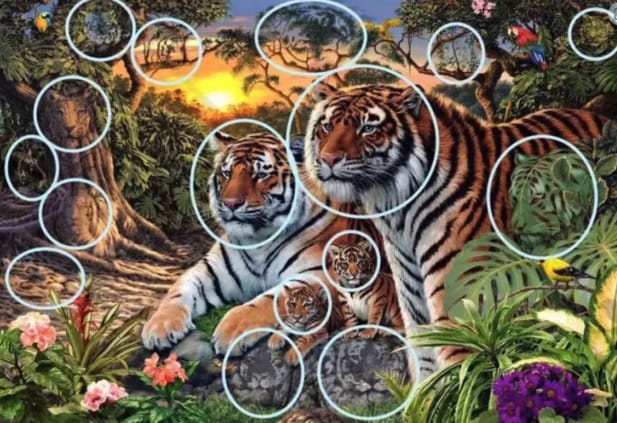
Next Challenge: The Tiger Family Illusion
If the dolphin hunt warmed your brain up, the tiger puzzle takes it up a level.
At first glance, it looks like a calm jungle scene with a few tigers relaxing in the greenery. But the real number hidden inside is said to be 16 tigers.
Just like the dolphin puzzle, some are obvious—others are disguised by foliage patterns, shadows, or blended into other tiger shapes. These are the ones that mess with you, because your brain registers “jungle texture” and stops searching.

How to spot more tigers
- Scan for repeated features: eyes, stripes, ears.
- Check the edges of the scene—illusion artists love hiding animals along borders.
- If there are plants or trees, look for shapes that resemble faces hiding in the leaves.

Bonus Puzzle: How Many Squares Are in the Image?
Then there’s the classic “count the squares” puzzle. It’s deceptively simple: you glance at the grid and think, “Okay, I’ve got it.”
Except… most people only count the big squares and miss the smaller ones inside, plus the overlapping combinations that create new squares.
The claimed correct answer here is 40 squares.
If you got 40, that means you didn’t just count what was obvious—you caught the layered squares that form when smaller sections combine into larger ones.
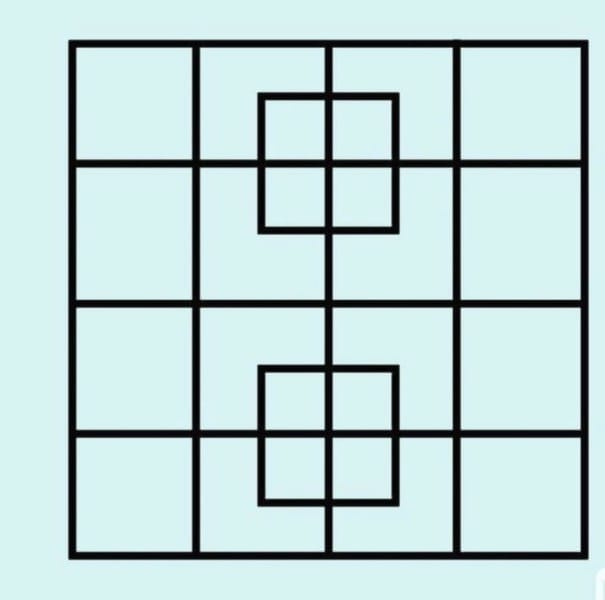
A quick method to count squares without going cross-eyed
- Count all smallest squares first.
- Then count squares made of 2×2 blocks.
- Then 3×3, and so on, until the largest.
- Don’t forget any “extra” squares formed by overlapping sections.
Why These Puzzles Mess With Our Brains
These teasers aren’t just a time-killer—they highlight how your brain works when it’s trying to be efficient.
Your mind is constantly:
- Filling in missing details
- Grouping shapes automatically
- Assuming patterns instead of double-checking them
That’s why you can stare at a dolphin illusion for a full minute and still miss one that’s hiding in plain sight.
Your Turn
So—how did you do?
- Did you find all 17 dolphins?
- Were you able to locate 16 tigers?
- Did you count 40 squares on the first attempt?
If you want, paste the images (or screenshots) here and I can mark up a “solution guide” showing where each dolphin/tiger/square is located—so you can compare your count with the intended answer.
More From Daily Positive
 Woman pours water over neighbor’s son after he did the same to her cat
 My Family Uninvited Me from the Aspen Trip — They Didn’t Know I Owned the Mountain.
 I stepped into the notary’s office fully aware my ex-husband, his lover, and his mother would be there… but when the will was opened, the attorney met my eyes and said, “Mrs. Rowan… I’m very glad you’re here.”
 I was in tears as I dropped my husband off at the airport, believing he was leaving for a two-year job in Canada — but the moment I got home, I moved the $650,000 into my own account and started divorce proceedings.
 Doctors reveal that eating tomatoes causes …
 When an elderly person goes through a delicate stage, these 4 changes may appear and deserve attention.