She was a trailblazer whose influence reached far beyond the recognition she received in her lifetime. Many people encountered her work without ever realizing just how much she had reshaped the way American history is told.
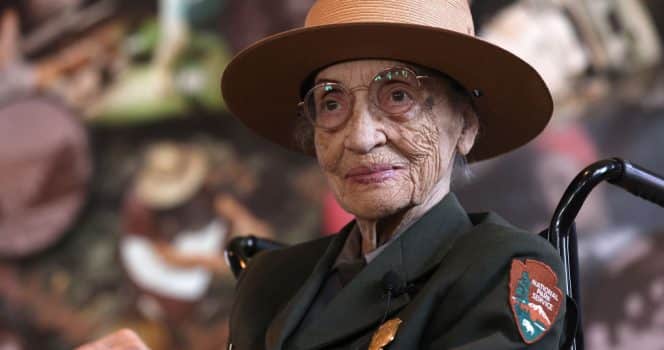
Betty Reid Soskin passed away peacefully on December 21, 2025, at the age of 104. At the time of her death, she was widely recognized as the oldest living National Park Service ranger, a distinction that symbolized not longevity alone, but an extraordinary commitment to truth, public memory, and justice. Her family shared that she was surrounded by loved ones and had “led a fully packed life,” adding that she was ready to leave after a century defined by purpose.
Her role with the National Park Service began later than most people’s retirements. Soskin joined the agency in her mid-80s and went on to transform the visitor experience at the Rosie the Riveter/World War II Home Front National Historical Park in Richmond, California. She didn’t merely interpret history — she challenged it. Soskin worked closely with city leaders and the Park Service to help shape the park’s management plan, insisting that the stories of African Americans and other marginalized communities be included in the official narrative of World War II. For her, history was incomplete if it excluded the people who labored, suffered, and contributed without recognition.
She officially retired in 2022 at the age of 100, becoming the oldest active ranger in the agency’s history. Yet even retirement never meant disengagement. Soskin continued speaking, advising, and reminding audiences that history is not static, and that the stories we choose to tell shape the future just as much as the past.
Born Betty Charbonnet in Detroit in 1921, Soskin’s life spanned nearly every major chapter of modern American history. Her family, a Cajun-Creole African American household, later moved through New Orleans and eventually to Oakland, part of a broader migration of Black families fleeing the violence and restrictions of the Jim Crow South. Her memory held vivid details of a changing nation — ferry boats crossing the Bay before bridges existed, Oakland’s airport when it was little more than two hangars, and the shock of national tragedies like the Port Chicago explosion during World War II.
During the war, Soskin worked as a file clerk in a segregated union hall, an experience that deeply shaped her understanding of inequality on the so-called home front. While popular narratives celebrated unity and prosperity, she lived the reality of exclusion and limited opportunity. Decades later, those experiences became central to the interpretive programs she led, giving visitors a fuller, more honest understanding of American history.

In 1945, she and her husband founded Reid’s Records, one of the first Black-owned music stores in the United States. The shop became a cultural cornerstone in the Bay Area and remained open for more than seventy years, reflecting Soskin’s enduring belief in community, creativity, and cultural preservation. Her public service extended into government as well, where she worked with local and state leaders in Berkeley and across California, always advocating for equity, inclusion, and historical truth.
Recognition eventually followed. In 2015, President Barack Obama invited Soskin to light the National Christmas Tree, honoring her life’s work and presenting her with a commemorative coin bearing the presidential seal. She later described the moment as something she never could have imagined, yet one that affirmed the value of a lifetime spent pushing against silence and omission.
Even in her final years, Soskin remained sharply engaged with the world around her. She followed politics closely and spoke candidly about her concerns for the country’s direction, reflecting on the civil rights progress she had witnessed and the fear that hard-won gains could be lost. For someone who had spent over a century fighting for justice and truth, the idea of leaving the world in a state of uncertainty weighed heavily on her.
Soskin died at her home in Richmond, California, leaving behind a legacy that extends far beyond any single role or title. A public memorial will be announced at a later date, and her family has encouraged donations to causes connected to her work, including Betty Reid Soskin Middle School and the completion of her documentary, Sign My Name to Freedom — a phrase that perfectly captures the spirit of her life.
Betty Reid Soskin did more than witness history. She corrected it, expanded it, and ensured that voices long ignored would finally be heard. Her life stands as a reminder that truth matters, that memory is powerful, and that it is never too late to change how a nation tells its story.
More From Daily Positive
 Cardiologist issues health warning to anyone that takes Omeprazole or Ibuprofen
 I Raised My Best Friend’s Son as My Own—12 Years Later, One Secret Nearly Destroyed Our Family
 I Secretly Fed a Lonely Elderly Woman for 3 Years — On My 18th Birthday, I Learned the Truth She Never Told Me
 Parkland Survivor Donovan Metayer Dies at 26, Renewing Focus on Trauma’s Long Reach
 Maxine Waters INSULTS John Kennedy With the Words “Sit Down, Boy” — And the Moment Instantly Changes the Entire Room
 She Could Not Afford a Birthday Cake Yet One Small Act of Kindness Changed Everything for Her Son