The remarks made by Billie Eilish** at the 68th Grammy Awards have continued to generate debate—this time prompting a response from the Native American tribe whose ancestral land includes parts of Los Angeles, where the singer owns a multimillion-dollar home.
“No one is illegal on stolen land”
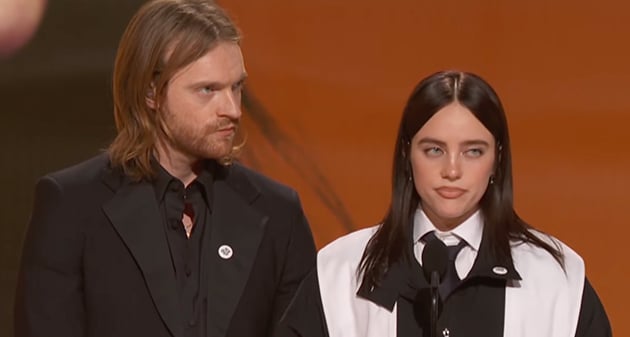
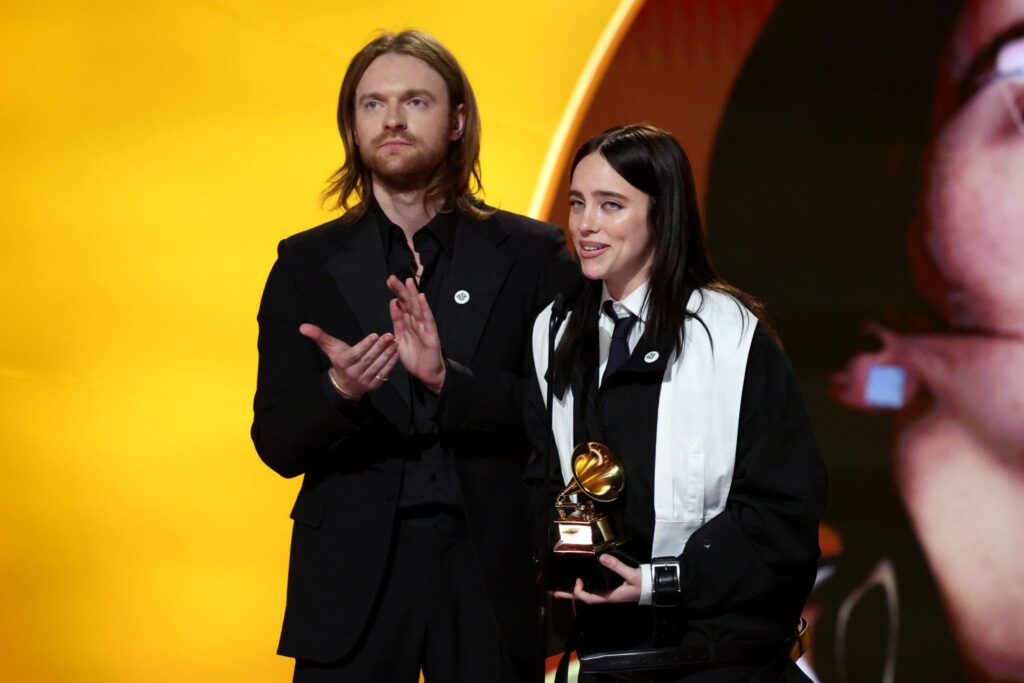
On February 1, Eilish, 24, accepted Song of the Year for “Wildflower,” standing alongside her brother and collaborator Finneas. During her speech, she used the moment to address immigration and enforcement policies, stating:
“As grateful as I feel, I honestly don’t feel like I need to say anything but that no one is illegal on stolen land.”
She followed with:
“And f**k ICE, that’s all I’m gonna say, sorry!”
The comments referenced the history of European colonization in North America and were widely circulated online within hours. Supporters applauded her for speaking candidly about immigration and Indigenous history on a major televised platform. Critics, however, quickly questioned the consistency of her message—particularly in light of her Los Angeles property.
Tongva tribe responds
Los Angeles sits on the ancestral land of the Gabrieleno Tongva people. Following the public reaction, a spokesperson for the Tongva tribe addressed the situation in comments to The Daily Mail.
“We appreciate the opportunity to provide clarity regarding the recent comments made by Billie Eilish,” the spokesperson said. “As the First People of the greater Los Angeles basin, we do understand that her home is situated in our ancestral land.”
The statement noted that Eilish had not directly contacted the tribe regarding her property. However, the tribe expressed appreciation for public figures who bring visibility to Indigenous history.
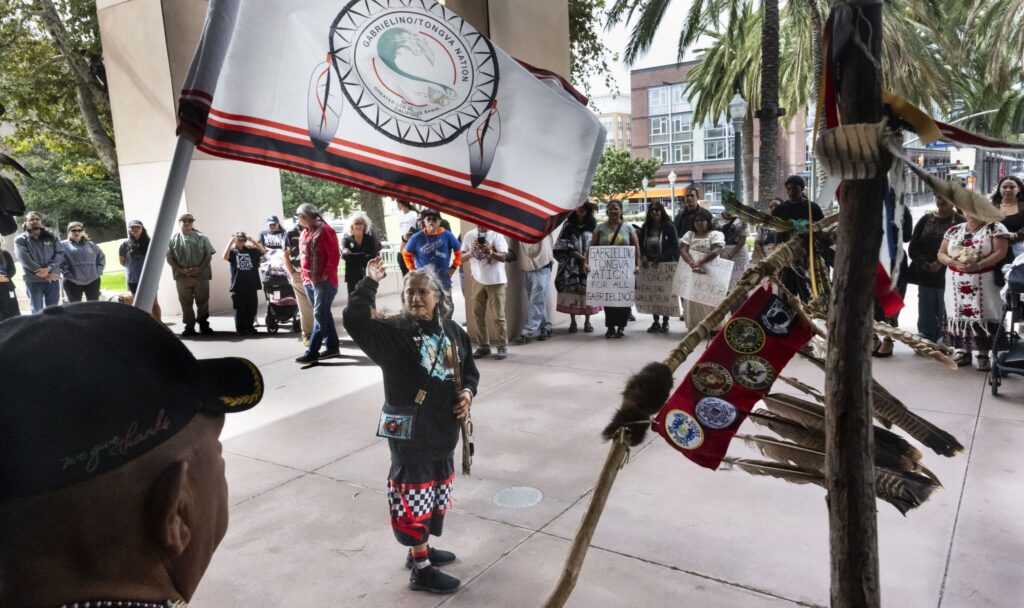
“It is our hope that in future discussions, the tribe can explicitly be referenced to ensure the public understands that the greater Los Angeles basin remains Gabrieleno Tongva territory,” the spokesperson added.
According to reports, representatives for the tribe reached out to Eilish’s team to convey their acknowledgment and perspective.
Calls for action—and backlash
In the days following the speech, commentary intensified across social media platforms. Some users suggested that if Eilish believes in the concept of “stolen land,” she should return her Los Angeles mansion to the Tongva tribe or open it to undocumented migrants.
Political commentator Eric Daugherty posted on X that Eilish should “return her mansion” or “host illegal aliens” if she stands by her remarks.
Several conservative figures echoed similar sentiments. Senator Mike Lee wrote that anyone making a public “stolen land” acknowledgment should “immediately give his or her land to Native Americans.” Minnesota state Rep. Walter Hudson questioned why individuals invoking the phrase do not “donate everything and leave.”
Florida Governor Ron DeSantis characterized the remarks as “stolen land nonsense,” while Tesla CEO Elon Musk responded with a brief “Exactly” to a related post.
Others adopted a more sarcastic tone, criticizing what they view as a disconnect between celebrity activism and personal wealth.
Broader immigration debate
Eilish has previously criticized the U.S. Immigration and Customs Enforcement agency, commonly known as ICE, alleging misconduct and heavy-handed tactics in enforcement operations. Her Grammy comments reinforced that long-standing position.
The controversy unfolded amid continued national debates over immigration enforcement and high-profile ICE raids, including recent incidents in Minneapolis that reignited discussion around federal immigration policy and its consequences.
A familiar tension
The exchange highlights an ongoing tension in American public discourse: the intersection of celebrity advocacy, historical accountability, property ownership, and immigration reform.
For supporters, Eilish’s speech represented a willingness to use a high-profile moment to spotlight systemic issues tied to colonization and migration. For critics, it underscored what they perceive as inconsistency between rhetoric and personal circumstance.
The Tongva tribe’s measured response added another layer—recognizing the historical truth of Indigenous land while encouraging more explicit acknowledgment in public conversations about Los Angeles and its origins.
As the debate continues, it raises broader questions about what acknowledgment requires in practice, how public figures navigate activism while maintaining private property, and how Indigenous communities themselves wish to be represented in these discussions.
Eilish has not publicly expanded on her Grammy remarks since the ceremony.
More From Daily Positive
 My MIL Said, 'Give My Son a Boy or Get Out' – Then My Husband Looked at Me and Asked, 'So When Are You Leaving?'
 My Son Refused to Invite Me to His Wedding Because I'm in a Wheelchair – After I Sent Him One Thing, He Begged Me to Forgive Him
 Sad news for drivers over 70 as new safety discussions raise questions about age, vision, reflexes, and whether older motorists should face additional testing, sparking debate about independence, fairness, and how to keep everyone safe on the road.
 For over a decade, Savannah Guthrie has been the steady, comforting v
 Hidden Risks: Everyday Male Behaviors That Can Affect a Woman’s Intimate Well-Being
 Man Detained After Allegedly Contacting Family During Nancy Guthrie Investigation