From Small-Town Indiana to Rock Legend: The Fierce Journey of Axl Rose
He was born William in a quiet Midwestern town, raised under rigid religious rules and buried family secrets. Somehow, that boy from Lafayette, Indiana, would become Axl Rose – the volatile, magnetic frontman of Guns N’ Roses and one of rock’s most recognizable voices.
A childhood ruled by fear, control, and secrets
Axl Rose entered the world in Lafayette in February 1962. His mother was just 16, his father 20 – a “troubled” local known more for chaos than stability. The marriage fell apart when William was still a toddler. Not long after, his biological father abducted and allegedly abused him before disappearing from Lafayette for good. Years later, that father would be murdered in Marion, Illinois, without Axl ever seeing him again as an adult.
His mother remarried Stephen L. Bailey, changed her son’s name to William Bruce Bailey, and raised him in a strict Pentecostal home. For most of his childhood, he believed Bailey was his real father.
The household was intensely religious and deeply controlling. One week there’d be a television, the next week it was in the trash because it was “Satanic.” Women were portrayed as dangerous, desire as sinful, and the outside world as corrupt. Axl later said that everything around him was labeled evil – even pop songs on the radio. When he once sang along to Barry Manilow’s “Mandy,” his stepfather hit him for it.
Rose has spoken openly about how that environment warped his view of women and trust. He’s said his mother chose his abusive stepfather over him and often stood by while he was beaten, only comforting him afterward. That sense of abandonment and anger later seeped into his lyrics and his rage on stage.
Trying to escape Indiana – and himself
School never felt like a haven. By eighth grade, the red-haired kid from Lafayette had a reputation for mouthing off and dreaming big. Teammates on his cross-country squad mocked him when he insisted he’d one day “make it.” A coach later recalled how other kids shoved him in lockers and taped his mouth shut while he kept talking about his future.
Music was his only real outlet. He sang in the church choir, performed as part of “the Bailey Trio” with his siblings, and took piano lessons. Teachers remembered him as charismatic and bright – the kind of kid who could take over a classroom if you weren’t careful.
In his late teens, he discovered the truth about his biological father. The revelation, paired with years of control and abuse, pushed him into open rebellion. He clashed with police, was arrested many times, and later said he was diagnosed with bipolar disorder after a psychiatrist mistook his explosive behavior for psychosis. Indiana, he felt, was less a home than a prison.
Facing the prospect of habitual-offender charges, he left Lafayette for Los Angeles in late 1982, determined to reinvent himself.

Becoming Axl Rose – and creating Guns N’ Roses
In Los Angeles, William Bailey began chasing the dream that had gotten him laughed at in high school. Influenced by bands like Queen, Aerosmith, and Elton John, he fronted a group called AXL. Friends urged him to take the band’s name as his own; he eventually did, legally changing it to W. Axl Rose in honor of his biological family name.
By 1985, the seeds of a legendary band had been planted. Members of two local outfits – Hollywood Rose and L.A. Guns – fused to become Guns N’ Roses. The classic lineup solidified soon after: Axl Rose on vocals, Slash on lead guitar, Izzy Stradlin on rhythm guitar, Duff McKagan on bass, and Steven Adler on drums. Signed to Geffen Records in 1986, they were rough, hungry, and unlike anything else on the Sunset Strip.
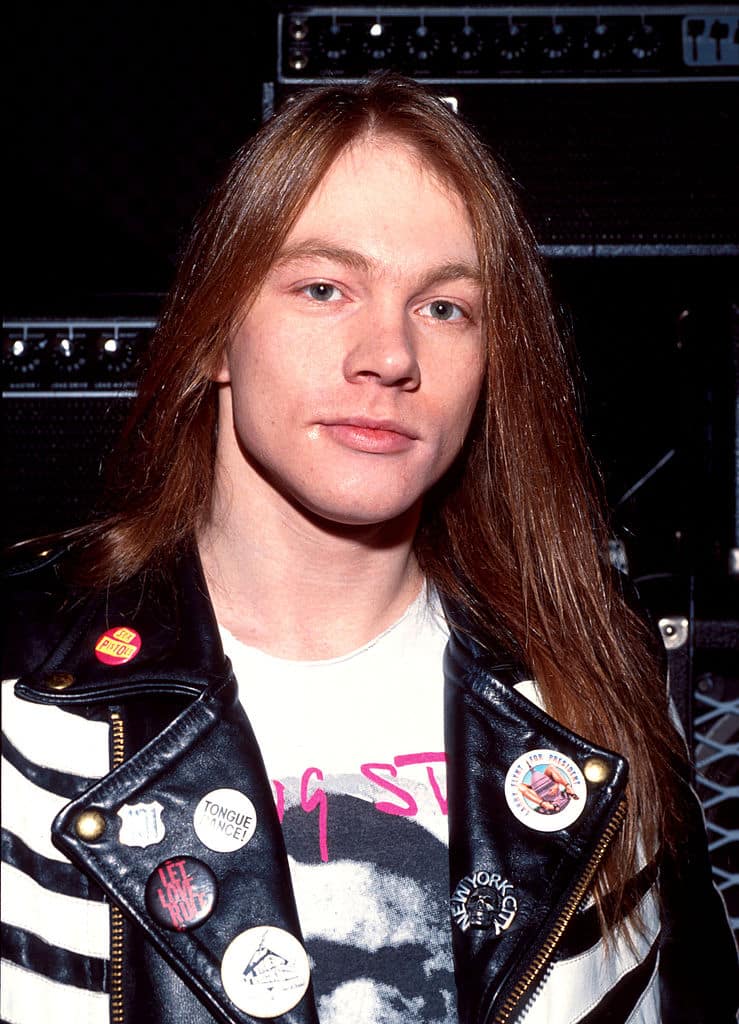
Appetite, superstardom, and chaos
In July 1987, GN’R released their debut album, Appetite for Destruction. At first, it moved slowly – about half a million copies in its first year. But relentless touring and the gritty video for “Welcome to the Jungle” began to build a cult following. When “Sweet Child o’ Mine” hit No. 1, the record exploded, eventually topping the U.S. charts.
Louder
Over time, Appetite for Destruction sold more than 30 million copies worldwide, including roughly 18 million in the United States, making it the best-selling debut album in U.S. history.
Axl’s high-wire voice, his snakelike stage moves, and his refusal to play nice with anyone – media, industry, or audience – made him one of rock’s most electrifying and unpredictable frontmen. That volatility had a cost. In 1991 in St. Louis, he famously dove into the crowd to stop a fan filming the show, then walked off with a parting shot at security, triggering a riot and a storm of legal trouble.

Love, damage, and reckoning
Behind the scenes, his relationships were as intense and turbulent as his performances. In the late ’80s, he began a serious relationship with model Erin Everly, who initially helped support them financially while he struggled as a musician. Axl wrote “Sweet Child o’ Mine” for her, and she appeared in the video.
But the marriage that followed was short and painful. Everly later described emotional and physical abuse, a traumatic pregnancy, and a miscarriage. Their union was annulled in 1991, and she later filed a civil suit that was settled privately.
Publicly, Axl admitted he didn’t want children because he couldn’t imagine dividing his time between a family and a career. At the same time, he was starting to confront the damage his upbringing had done.
In a candid interview, he said therapists told him his “mental circuitry” for handling stress was twisted by what happened in Indiana, and that he used to cope by smashing whatever was around him rather than processing what he felt. Those outbursts, once seen as pure rock-star tantrums, were also the fallout of deep, untreated wounds.
A complicated icon who still won’t play by the rules
Decades later, Axl Rose is widely regarded as one of rock’s greatest singers, praised for a range that can snarl, howl, and soar within a single song. Publications like Rolling Stone and NME have ranked him among the most powerful vocalists in the genre, and in 2012 he was inducted into the Rock & Roll Hall of Fame as part of Guns N’ Roses – though in classic Axl fashion, he declined to attend and asked not to be included in the Hall’s displays.
Wikipedia
He has continued to tour stadiums around the world, reuniting with key GN’R members and performing the albums that made them legends, even as age and years on the road have changed his once-piercing voice. In late 2025, a show in Buenos Aires made headlines when he abruptly left the stage after struggling with in-ear sound problems, a reminder that his perfectionism and intensity remain as sharp as ever.
From a childhood of violence, secrecy, and religious control to the glare of global fame, Axl Rose’s story is not a neat redemption arc. It’s messy, loud, and unresolved – much like the music that made him famous. But one thing is undeniable: he took the pain that could have broken him and turned it into songs that still shake arenas, proving that even the darkest beginnings can fuel a voice the world will never forget.
