Donald Trump has long had a combative relationship with the press, but in recent weeks, his sharpest attacks have been aimed predominantly at female reporters — a pattern that has drawn renewed public scrutiny. The White House insists his remarks have “nothing to do with gender,” yet the frequency and tone of his comments have sparked widespread debate.
What once would have been unthinkable for a sitting U.S. president — publicly mocking a journalist’s appearance or using ableist slurs against elected officials — has slowly become routine. The latest string of incidents has only heightened concerns.
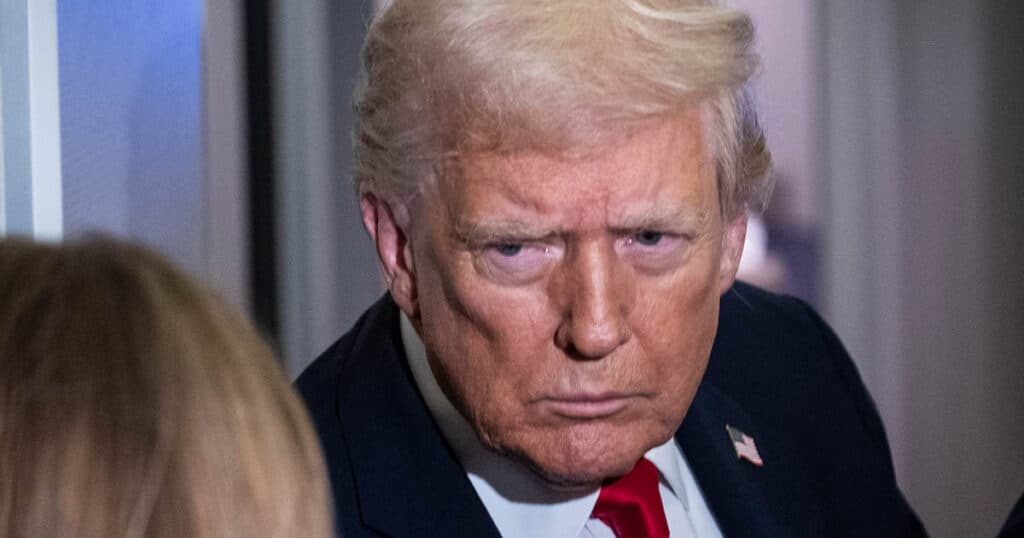
In November, Trump ignited outrage when he told a Bloomberg White House correspondent, who pressed him on the Epstein files, “Quiet, piggy.” Days later, he went after a female CNN reporter, calling her “nasty” and “stupid,” continuing a pattern of dismissive hostility toward women asking him difficult questions.
Thanksgiving week brought no pause. On Truth Social, Trump targeted Minnesota Governor Tim Walz with an ableist slur before directing xenophobic language at Rep. Ilhan Omar, calling her “the worst ‘Congressman/woman’ in our Country… always wrapped in her swaddling hijab.” And during another exchange with a female journalist who asked about a suspect in an attack on National Guard members in Washington, D.C., he shot back, “Are you stupid? Are you a stupid person?”
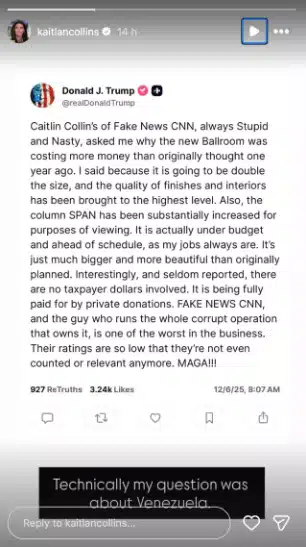
CNN’s chief White House correspondent, Kaitlan Collins, soon became another target. After she questioned him during a press conference about renovations at the White House — including a privately funded ballroom Trump insists is “under budget and ahead of schedule” — he lashed out hours later in a Truth Social post, misspelling her name and writing:
“Caitlin Collin’s of Fake News CNN, always Stupid and Nasty…”
CNN issued a clear response, calling Collins “an exceptional journalist… audiences around the world know they can trust.” Collins herself offered a quiet correction on Instagram, noting, “Technically my question was about Venezuela” — referring to a deadly bombing off the Venezuelan coast that killed more than 80 people, widely condemned amid concerns of a potential “double tap.” The Pentagon has denied any wrongdoing, stating that current operations remain lawful under U.S. and international law.
At the same time, Trump has pushed back against reporting on his own stamina. After The New York Times wrote that he was showing “signs of fatigue” and confronting “the realities of aging in office,” Trump attacked the outlet online, saying:
“The Creeps at the Failing New York Times are at it again… I have never worked so hard in my life.”
He acknowledged that “there will be a day where my energy will run out,” but insisted his medical tests show “that won’t be anytime soon.” The Times stood firmly behind its reporting, with spokesperson Charlie Stadtlander saying, “Name-calling and personal insults don’t change that. Our journalists will not hesitate to cover this administration.”
Despite the unmistakable pattern of belittling female reporters, the White House rejects the notion that gender plays any role. “President Trump has never been politically correct, never holds back, and in large part, the American people re-elected him for his transparency,” spokeswoman Abigail Jackson told The Independent. “This has nothing to do with gender – it has everything to do with the fact that the President’s and the public’s trust in the media is at all-time lows.”
Whether the criticism is defiance, frustration, or political strategy, the sustained targeting of women in the press corps has added another layer to an already fraught relationship between the administration and the media — one that shows no signs of easing.
