Erika Kirk’s appearance at the State of the Union quickly became one of the most discussed moments of the night — and not solely because President Donald Trump referenced her late husband during his address.
On February 24, Trump delivered what was described as the longest State of the Union speech in U.S. history. Speaking before a sharply divided Congress and millions of viewers watching nationwide, the 79-year-old president struck a characteristically forceful tone. He praised Republican lawmakers, highlighted his administration’s accomplishments, criticized Democrats, and outlined ambitious plans for the months ahead.
At one point in the speech, Trump turned to the topic of religion and cultural renewal.
“I’m very proud to say that during my time in office, both the first four years, and in particular this last year, there has been a tremendous renewal in religion, faith, Christianity and belief in God,” he said.
“This is especially true among young people, and a big part of that had to do with my great friend Charlie Kirk, great guy.”
Charlie Kirk — founder of Turning Point USA — was shot and killed on September 10, 2025, while speaking at a TPUSA event in Utah. His death sent shockwaves through conservative circles and sparked renewed conversations about political violence in America. Weeks later, his wife, Erika Kirk, stepped into a leadership role as the organization’s CEO, pledging to carry forward her husband’s mission.
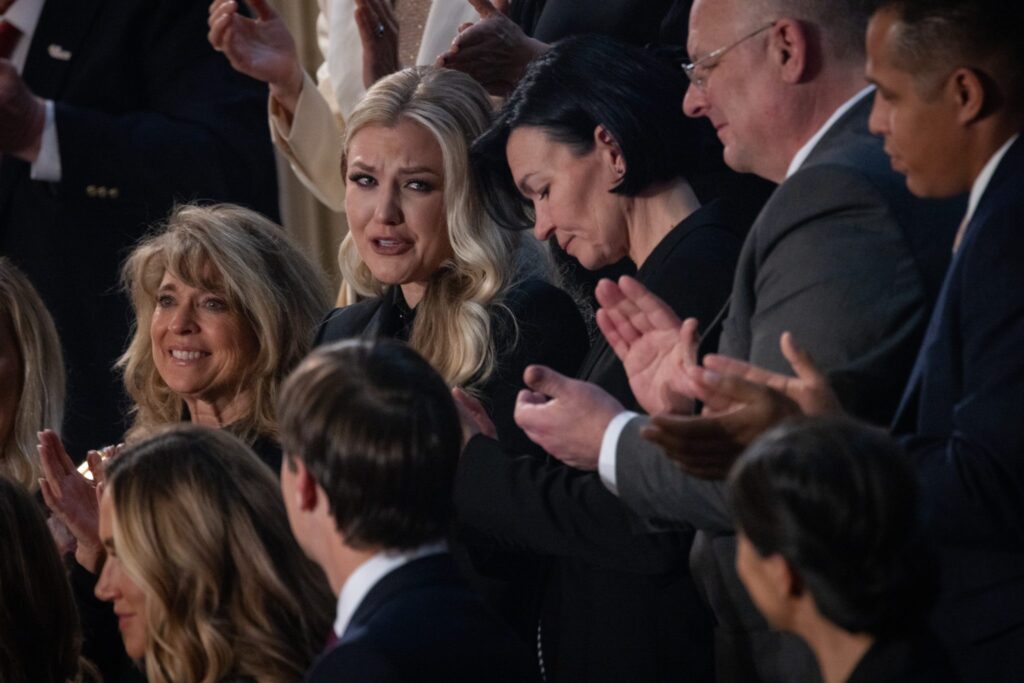
As Trump honored Charlie during the address, cameras focused on Erika seated in the gallery. She appeared emotional, dabbing her eyes as applause filled the chamber.
“Erika has been through a lot. In Charlie’s memory, we must all come together to reaffirm that America is one nation under God, and we must totally reject political violence of any kind,” Trump added.
A widely circulated image captured Erika receiving applause inside the U.S. House chamber in Washington, D.C., reinforcing the solemn tone of the tribute.
Yet as often happens in today’s social media environment, the moment was instantly dissected online.
Some viewers questioned her reaction, suggesting it appeared performative. Others, however, saw something entirely different. Several users pointed out that she appeared to mouth the words “I miss you” after standing.
“Seeing Erika Kirk mouth ‘I miss you’ is heartbreaking,” one person wrote on X.
Another commented: “I’m not a lip reader, but it appears that Erika says: ‘I miss you.’ after standing up. You can see her struggling to keep her composure when hearing Charlie’s name.”
The divide in interpretations reflects a broader reality of high-profile political events: deeply personal moments unfold in front of a national audience, and every expression is replayed, analyzed, and debated in real time.
Meanwhile, legal proceedings continue in connection with Charlie Kirk’s death. Tyler Robinson, the alleged gunman, is facing a capital case related to last year’s shooting.
Beyond the tribute itself, the State of the Union highlighted the broader political rift in Washington. Several Democratic lawmakers chose not to attend the address, instead participating in rallies across the capital in opposition to Trump’s agenda. The visual divide inside and outside the chamber underscored the nation’s ongoing polarization.
There was also a moment of protest within the chamber. Al Green of Texas was escorted out for the second consecutive year after holding up a white sign that read, “Black people aren’t apes!” as the president entered. The incident added another layer of controversy to an already charged evening.
Taken together, the speech and its surrounding moments illustrated the current state of American politics — emotional, divided, and intensely scrutinized. For some viewers, the tribute to Charlie Kirk was a heartfelt acknowledgment of loss and a call to reject political violence. For others, it became another point of contention in a deeply partisan climate.
As reactions continue to circulate online, the evening serves as a reminder that in modern political life, personal grief, public leadership, and partisan debate often intersect on the same national stage.
More From Daily Positive
 Viewers spot odd details In Erika Kirk’s appearance at State of the Union
 BE CAREFUL, if you get these bumps on your body, it means you have ….
 My Aunt Tried to Evict Me from My Grandpa's Farm Right After He Died – but the Lawyer Said One Sentence That Made Her Go Pale
 Donald Trump’s 5-word swipe at Melania during State of the Union address has everyone talking
 All the grim things found inside Jeffrey Epstein’s abandoned “Lolita Express” plane
 With heavy hearts, we share the heartbreaking news of this Hollywood star’s daughter... How she died breaks our hearts