Cats have a reputation for being aloof, self-sufficient, and occasionally dramatic. But anyone who shares their home with one knows that many felines are secretly affectionate — sometimes overwhelmingly so.
If your cat gently bumps their forehead against you, you’ve probably wondered what it means. Is it playfulness? Attention-seeking? A quirky personality trait?
In reality, that soft “headbutt” carries a surprisingly tender message.
What Does It Mean When a Cat Headbutts You?
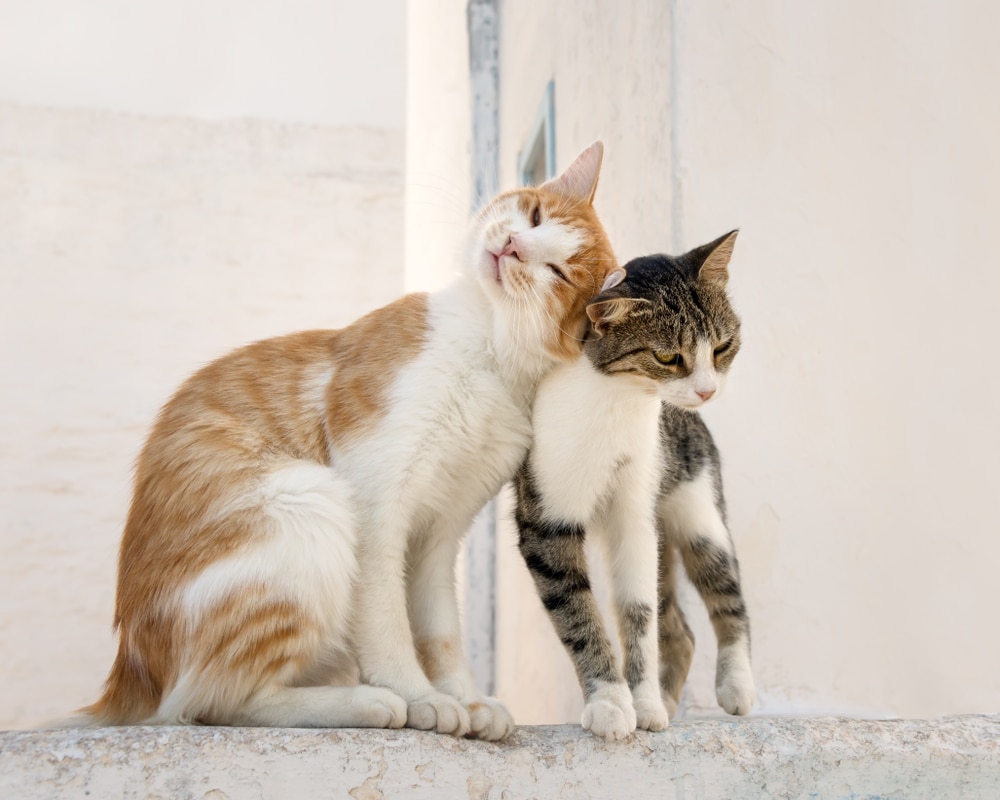
That little nudge has a name: bunting. It’s a common feline behavior and one of the clearest signs of trust and affection.
When your cat presses their head against you, they’re not just being cute. They’re marking you — but not in the territorial, aggressive sense people often imagine. Instead, it’s social bonding.
Cats have scent glands around their cheeks, forehead, and chin. When they rub or bump you, they’re transferring their unique scent onto your skin or clothing. In feline language, that scent says: You belong with me.
It’s their version of a loving claim — quiet, gentle, and deeply instinctive.
It’s About Trust, Not Ownership
Unlike dogs, who may mark territory in more obvious ways, cats use facial pheromones to build familiarity and comfort within their environment.
When your cat bunts you, they’re essentially placing you in their “safe zone.” You become part of their inner circle — their chosen social group.
That’s not something they offer lightly.
Cats are selective about affection. If they’re headbutting you, it means they feel secure in your presence. They associate you with comfort and stability.
In simple terms? It’s very close to a kiss.
Not All Cats Show Love the Same Way
Of course, every cat has a distinct personality.
Some are natural cuddle enthusiasts — climbing into laps, kneading blankets, and showering their humans with head nudges. Others prefer affection on their own terms.
The key is paying attention to body language.
If your cat enjoys the interaction, you’ll likely notice:
Relaxed posture
Purring
Slow blinking
Gentle kneading
If they’re uncomfortable, the signals shift:
Tail flicking
Flattened ears
Tension in the body
Pulling away
Respecting those cues strengthens trust. Headbutting is meaningful precisely because it’s voluntary.
Big Cats Do It Too
Interestingly, this behavior isn’t limited to domestic cats.
In the wild, lions greet pride members with similar nuzzling gestures. It reinforces bonds and reaffirms social connection within the group.
The instinct runs deep. Whether it’s a house cat curled on your couch or a lion in the savanna, that gentle bump is a sign of familiarity and belonging.
The Role of Pheromones
Behind the sweetness lies biology.
Cats release pheromones — chemical signals that influence behavior and communication. Facial glands are especially important for this.
When your cat rubs against you, they’re coating you in their scent signature. That scent helps them feel calm and confident when they encounter you again.
It’s less about marking territory and more about reinforcing emotional security.
You’re not being claimed as property. You’re being included as family.
So, Next Time It Happens…
Pause and appreciate it.
That soft nudge isn’t random. It’s a quiet declaration of trust. Your cat feels safe enough to lower their guard and initiate contact.
Try this: the next time your cat approaches, soften your expression and slowly blink. Many cats respond to slow blinking as a sign of affection. You may find yourself rewarded with an extra head bump.
In a world where cats are often labeled distant or mysterious, bunting is a reminder that their love language is simply more subtle.
If your cat headbutts you regularly, consider it one of the highest compliments they can give.
{"post":48593,"page":1,"next":[{"id":48557,"url":"https:\/\/dailypositive24.com\/48557","title":"\u201cGet out of here, you wretch!\u201d The mother-in-law kicked her out into the street with an old suitcase after the funeral, never imagining the secret her son had left hidden in her pocket\u2026","image":"https:\/\/dailypositive24.com\/wp-content\/uploads\/2026\/03\/Tham_dinh_Ultra-realistic_cinematic_photo_35mm_lens_eye-level_shallow_de_e15d5ed9-b01d-4ebf-a919-f53dbc0bd577-768x1029.png"},{"id":48554,"url":"https:\/\/dailypositive24.com\/48554","title":"My 7-Year-Old Daughter and Her Father Began Having \u201cPrivate Talks\u201d in the Garage \u2014 So I Installed a Hidden Camera and Instantly Regretted It","image":"https:\/\/dailypositive24.com\/wp-content\/uploads\/2026\/03\/anh-post-2026-01-29T111954.610-768x922.jpg"},{"id":48551,"url":"https:\/\/dailypositive24.com\/48551","title":"I Became a Surrogate for My Sister \u0026 Her Husband \u2014 When They Saw the Baby, They Yelled, \u0027This Isn\u0027t the Baby We Expected\u0027","image":"https:\/\/dailypositive24.com\/wp-content\/uploads\/2026\/03\/Why-Is-My-Pregnant-Belly-Sometimes-Hard-and-Sometimes-Soft-768x360.png"},{"id":48543,"url":"https:\/\/dailypositive24.com\/48543","title":"Tucker Carlson slams Trump with 2 brutal words after his attack on Iran","image":"https:\/\/dailypositive24.com\/wp-content\/uploads\/2026\/03\/trump-2-664x350-1.jpg"},{"id":48538,"url":"https:\/\/dailypositive24.com\/48538","title":"An iconic singer-songwriter has left us - You\u0027ll cry when you recognize him","image":"https:\/\/dailypositive24.com\/wp-content\/uploads\/2026\/03\/ANES-664x350-1.jpg"},{"id":48535,"url":"https:\/\/dailypositive24.com\/48535","title":"My 15-year-old daughter had been complaining of nausea and stomach pain. My husband said, \u201cshe\u2019s just faking it. Don\u2019t waste time or money.\u201d I took her to the hospital in secret. The doctor looked at the scan and whispered, \u201cthere\u2019s somet","image":"https:\/\/dailypositive24.com\/wp-content\/uploads\/2026\/03\/623368396_1458996378952390_7139847973852350568_n-768x922.jpg"},{"id":48532,"url":"https:\/\/dailypositive24.com\/48532","title":"While I was away on a work trip, my Mother-in-law changed our house into two parts. She asked me to pay $100k for the changes. I said, \u2018Huh? But I\u2019m not married.\u2019 She replied, \u2018Huh?\u2019 The surprising truth came out, and her face went pale.","image":"https:\/\/dailypositive24.com\/wp-content\/uploads\/2026\/03\/645421686_1482951513223543_9001087469830981818_n-768x987.jpg"},{"id":48529,"url":"https:\/\/dailypositive24.com\/48529","title":"Entitled Woman Called Me, a 72-Year-Old Waitress, \u0027Rude\u0027 and Walked Out on a $112 Bill \u2013 I Showed Her She Picked the Wrong Grandma","image":"https:\/\/dailypositive24.com\/wp-content\/uploads\/2026\/03\/981c031d9855e43325f3aeac7f0d9c7afac7b54e6e1356ec6448a4de2f612508-768x384.jpg"},{"id":48526,"url":"https:\/\/dailypositive24.com\/48526","title":"Brave firefighter has face transplant after suffering third-degree burns, \u0026 survives against odds","image":"https:\/\/dailypositive24.com\/wp-content\/uploads\/2026\/03\/patrickhardison-2048x1075-1-768x403.jpg"},{"id":48523,"url":"https:\/\/dailypositive24.com\/48523","title":"I Was Picking Up Groceries for Lunch When I Heard a Little Boy Behind Me Say, \u0027Mom, Look! That Man Looks Exactly Like Dad\u0027","image":"https:\/\/dailypositive24.com\/wp-content\/uploads\/2026\/03\/ee741dac0ea1f0852971f60f65746074a41cc06aed28ebefdc05517f25e683b9-768x384.webp"},{"id":48520,"url":"https:\/\/dailypositive24.com\/48520","title":"\u201cJust stand up, stop faking it\u2026!\u201d my husband yelled when I lay paralyzed on the driveway. His mom accused me of ruining his birthday and seeking attention. but when the paramedic tested my legs, she immediately called for police backup.","image":"https:\/\/dailypositive24.com\/wp-content\/uploads\/2026\/03\/pitk.png"},{"id":48517,"url":"https:\/\/dailypositive24.com\/48517","title":"I thought the worst thing I\u2019d ever endure was bu.rying my little girl. Then my sister hijacked the funeral to flash a ring and preach about \u201cchoosing joy,\u201d smiling over my child\u2019s casket\u2014until her own son\u2019s voice cracked the room open with one sentence that made even the priest freeze.","image":"https:\/\/dailypositive24.com\/wp-content\/uploads\/2026\/03\/644067864_1482479626604065_4367572116129279946_n-768x1052.jpg"},{"id":48514,"url":"https:\/\/dailypositive24.com\/48514","title":"My 5-Year-Old Asked Why \u0027Mr. Tom\u0027 Only Comes at Night When I\u0027m Asleep \u2013 I Don\u0027t Know Any Toms, So I Set Up a Camera in Her Room and Waited","image":"https:\/\/dailypositive24.com\/wp-content\/uploads\/2026\/03\/m_fc0a0294-4950-410e-bc5f-417fca0c2af1.webp"},{"id":48511,"url":"https:\/\/dailypositive24.com\/48511","title":"I Raised My Granddaughter After My Family Died in a Snowstorm Crash \u2013 Twenty Years Later, She Handed Me a Note That Changed Everything","image":"https:\/\/dailypositive24.com\/wp-content\/uploads\/2026\/03\/grandpa_marquee_0-1024x576.jpg.optimal-768x432.jpg"}]}


 How a traumatic childhood shaped the life of a Hollywood icon
 My Husband Showed Up with a Cast on His Leg the Day Before Our First Family Vacation – Then I Got a Call That Changed Everything
 I took in a homeless man with a leg brace for one night because my son couldn’t stop staring at him in the cold. I left for work the next morning expecting him to be gone by evening.
 One of My Twin Daughters Died – Three Years Later, on My Daughter's First Day of First Grade, Her Teacher Said, 'Both of Your Girls Are Doing Great'
 Safest US states to be in if WW3 breaks out as fears grow following attack on Iran
 Trump’s name for Iran operation mocked as ‘childish’ and ‘stupid’ as death toll rises