Only months into 2026, some followers of Nostradamus are already claiming that one of his centuries-old predictions has begun to unfold.
As global headlines fill with images of extreme weather, political instability, and unsettling natural phenomena, believers argue that the Renaissance seer’s cryptic verses may once again be echoing through modern events.
Whether coincidence or interpretation, the conversation has reignited interest in one of history’s most debated prophetic figures.
Michel de Nostredame — better known as Nostradamus — was a French physician and astrologer born in 1503. He rose to prominence after publishing Les Prophéties in 1555, a collection of 942 poetic quatrains written in deliberately obscure language. The verses blend archaic French, Latin, and symbolic imagery, making them famously open to interpretation.
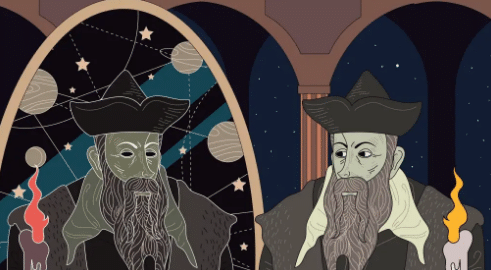
Supporters over the centuries have claimed his writings foretold events such as the Great Fire of London, the rise of Napoleon, the September 11 attacks, the death of Princess Diana, and even the COVID-19 pandemic. Critics, however, point out that the vagueness of his language allows readers to retroactively match predictions to almost any major event.
For 2026, interpreters highlight four particularly ominous themes.
The first speaks of a “great swarm of bees” emerging during a nighttime assault. Some see this as symbolic of coordinated military or political movements. Others speculate it could represent technological “swarms” — drones, digital networks, or even invasive species spreading across borders.
The second prophecy references rivers “overflowing with blood,” specifically mentioning the Swiss region of Ticino. Switzerland’s long-standing neutrality makes the imagery especially unsettling for believers, who interpret it as a warning that no nation is immune to upheaval.
A third vision invokes the god Mars — often associated with war — describing sacred sites stained with blood, “three fires” rising in the East, and the West losing its light in silence. Some interpret this as a metaphor for large-scale global conflict, while others see it as symbolic of geopolitical power shifts or rapid technological expansion in Eastern nations alongside Western decline.
The final prediction describes a “great man” struck down suddenly by a thunderbolt in broad daylight — often read as the unexpected death of a prominent political leader, royal, or celebrity.
Of these, the prophecy attracting the most attention so far centers on the imagery of rivers running red.
Although Switzerland itself has not experienced violence matching the literal interpretation, recent global events have fueled renewed speculation. Severe flooding across parts of the United Kingdom — including coastal damage in Devon and Cornwall — brought dramatic images of destruction to international news outlets. Sea walls collapsed, historic structures were damaged, and communities faced costly repairs.
Beyond Europe, climate-related flooding risks are increasingly under scrutiny. New research published in the Natural Catastrophe Review 2026 by Willis Towers Watson suggests that flood-related economic losses in Southeast Asia could multiply dramatically in the coming years due to intensifying storms. Scientists note that rising ocean temperatures contribute to stronger tropical systems and more erratic weather patterns.
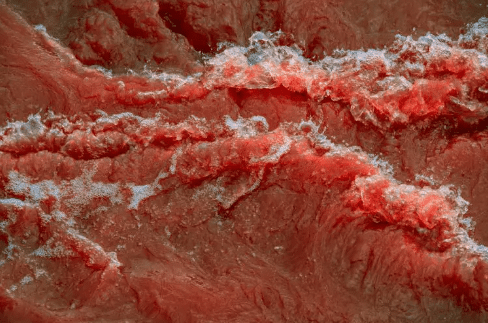
One of the most visually striking moments occurred in December when torrential rainfall on Iran’s Hormuz Island turned streams and coastal waters a vivid red. Viral footage showed rainwater mixing with iron-rich soil, producing dramatic crimson runoff cascading toward the sea. Scientists quickly explained the phenomenon as a natural reaction involving iron oxide deposits common to the island’s mineral landscape.
Yet for many observers, the timing and imagery — just weeks before the new year — carried symbolic weight. Throughout religious and cultural history, red waters have often been linked to apocalyptic imagery, including references found in the Book of Revelation.
Experts emphasize that natural explanations account for these events. Iron-rich soil, rising global temperatures, and documented weather patterns provide scientific context. At the same time, Nostradamus’s enduring appeal lies precisely in his ambiguity — the ability of his words to feel relevant across centuries.
Whether one views these developments as prophetic fulfillment or the product of selective interpretation, the renewed attention underscores a broader truth: in times of uncertainty, people often look backward to find meaning in the present.
As 2026 continues to unfold, debate over Nostradamus’s predictions is unlikely to fade. History suggests that as long as major global events occur — and as long as his verses remain open to interpretation — the 16th-century seer will continue to be woven into modern headlines.
More From Daily Positive
 A Birthday Surprise That Transformed How I See Everyday Kindness
 My Daughter ‘Went to School’ Every Morning – Then Her Teacher Called and Said that She’d Been Skipping for a Whole Week, So I Followed Her the Next Morning
 Signs Of High Blood Sugar: These People Are Most at Risk of Developing Diabetes
 I Decided to Wear My Grandmother's Wedding Dress in Her Honor – But While Altering It, I Found a Hidden Note That Revealed the Truth About My Parents
 A little girl went to a police station to confess a serious crime, but what she said left the officer completely shocked.
 After a snowstorm acci:dent took my entire family, I raised my granddaughter alone. Twenty years later, she placed a note in my hands – one that completely transformed everything I believed to be true.