When Crysie and Ryan Grelecki learned they were expecting a baby in 2008, they imagined the same thing most hopeful parents do — a healthy child, a smooth delivery, and a future full of ordinary joys. But halfway through the pregnancy, that dream was suddenly shaken by terrifying news.
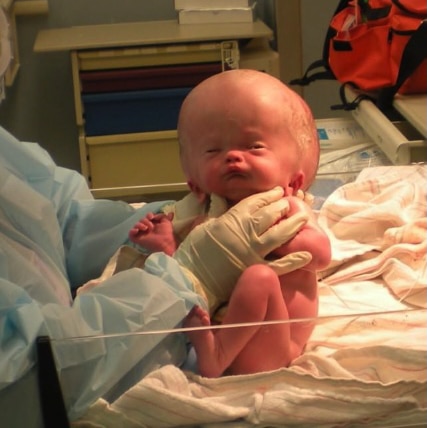
At the 20-week ultrasound, the nurse noticed something deeply concerning. Their unborn son’s head was much larger than expected. Doctors were called in, scans were reviewed, and the couple soon learned their baby was facing a severe medical crisis. Their son, Parker, had hydrocephalus, a condition that causes fluid to build up in the brain. In his case, a blockage between the third and fourth ventricles prevented spinal fluid from draining, forcing the fluid to collect inside his skull and compress the brain tissue against the bone.
For most parents, such news would be devastating beyond words. For Crysie and Ryan, it was exactly that. But even in the fear, they never stepped away from their son. They chose love first.
As Crysie later shared, there were many moments during the pregnancy when fear threatened to consume her. But again and again, she found herself returning to the same words of comfort: “God will make a way, when there seems to be no way.” That belief became her anchor as the pregnancy moved forward under a cloud of uncertainty.
When Parker was born in September 2008 by C-section at 39 weeks, the numbers were staggering. A typical newborn has a skull made up of about 90 to 95 percent brain matter and only a small amount of fluid. Parker’s condition was dramatically different. His skull contained more than 98 percent fluid and only a tiny amount of brain tissue — just eight millimeters pressed thinly against the bone.
The outlook was grim. Doctors warned the family to prepare for the worst. No one knew whether Parker would survive, let alone what kind of future he might have if he did. But from the very beginning, he was surrounded by fierce love.
Ryan later recalled standing beside his baby boy, talking to him, praying over him, holding his hand, and rubbing his head. There was nothing he could do to fix the situation with his own hands, but the love he felt for Parker was immediate and overwhelming.
At only two days old, Parker underwent the first critical step in what would become a long and remarkable medical journey. Specialists at Children’s Healthcare of Atlanta began draining the excess fluid from his skull to relieve the crushing pressure. That simple but life-saving intervention gave his brain room to grow.
From there, Parker began enduring surgery after surgery. Doctors performed complex craniofacial procedures to expand his skull and separate bones that had fused too early. The goal was not simply survival. It was to create the physical space his brain needed to develop as normally as possible.
And somehow, against expectation after expectation, Parker kept fighting.
Just two weeks after surgery, he was well enough to go home. Four weeks later, he began physical therapy. By the time he reached 20 months old, he had already undergone seven successful operations. Progress came slowly at first. His mother said it took time for him to hold up his head and sit on his own. But little by little, he found his way forward.
Then came another surprise. Parker skipped crawling altogether and went straight to walking.
For his parents, every milestone felt like a miracle. For the hospital staff who cared for him, he became much more than a patient. The Grelecki family often spoke of Children’s Healthcare of Atlanta as an extension of their own family, and it is easy to understand why. The doctors, nurses, and therapists stood beside Parker through each stage of recovery, helping him build strength and defy predictions that once seemed immovable.
As he grew older, Parker continued therapy in creative and joyful ways. He played tennis. He took swimming lessons. He stayed active with the support of his siblings, Chase and Emily, who became some of his strongest cheerleaders. Growing up beside Parker gave them a deeper sense of compassion and made them advocates for people with special needs.
Today, Parker looks almost nothing like the fragile newborn doctors once feared might not survive. With his blond hair, glasses, and bright personality, he has grown into a young man who has exceeded nearly every expectation placed in front of him. He does well in school, connects easily with people, and has a charisma that leaves a strong impression almost immediately.
Those who meet him quickly realize that he is not defined by the condition he was born with. He is funny, talkative, loving, and deeply engaging. In fact, one of the most striking things about Parker is the way he lights up when talking about sports. For years, he has dreamed of becoming a sports commentator, and by all accounts, he has real talent for it. He has already had opportunities to announce local high school football games, and people who hear him say his knowledge, energy, and presence are unforgettable.
That same brain doctors once doubted could sustain a normal life now holds a remarkable store of sports knowledge and a gift for sharing it.
Parker still faces challenges related to the damage caused by hydrocephalus, and his journey has never been easy. But his life stands as a powerful reminder that prognosis is not destiny, and that human strength — especially when wrapped in unconditional love — can reach astonishing places.
His parents have often said they are beyond grateful to watch him grow and continue living out the plans they believe God has for him. And perhaps that is what makes Parker’s story so moving. It is not only about medicine, though medicine saved him. It is not only about survival, though he survived against the odds. It is about love that refused to let fear have the final word.
Parker Grelecki entered the world under the darkest predictions. Yet year after year, he kept proving that there was still room for hope, still room for joy, and still room for miracles.
And in that way, his story became far bigger than one little boy’s fight.
It became a story of a family who chose faith over despair, of doctors who made room for life where there seemed to be none, and of a child who never stopped moving toward a future everyone else had been too afraid to imagine.
More From Daily Positive
 The daughter-in-law was still asleep at 11 a.m., and her mother-in-law stormed in with a stick to teach her a lesson — but what she saw on the bed froze her in place.
 My Husband Moved Into the Guest Room Because He Said I Snored — but I Was Speechless When I Found Out What He Was Really Doing There
 My mother-in-law refused to care for my 3-month-old baby, tying her to the bed all day. “I fixed her because she moves!” When I returned from work, my baby was unconscious. I rushed her to the hospital, where the doctor’s words left my mother-in-law speechless.
 Before you open another can of sardines, check this out!
 ‘The Crown’ & ‘Downton Abbey’ actress Jane Lapotaire dead at 81
 Does eating boiled eggs regularly benefit or harm the liver?