Whenever Jamie Lee Curtis steps onto a red carpet, there’s a certain unpredictability that comes with it—not chaos, but candor. And at the recent Las Culturistas Culture Awards, that quality was on full display in a moment that quickly spread across social media.
The interaction unfolded when Curtis spotted Allison Janney arriving in a striking outfit—one that leaned boldly into high-fashion territory with a blazer-forward look. Curtis didn’t respond with the usual polite compliment or rehearsed enthusiasm. Instead, she blurted out, “You can go f**k yourself,” before immediately embracing Janney.
Out of context, the phrase might sound harsh. In reality, it read as something else entirely—an exaggerated, almost theatrical form of admiration. The tone, the body language, and the immediate hug made it clear: this was not criticism, but praise delivered in Curtis’s unmistakably unfiltered style.
Janney herself leaned into the humor, later sharing the moment on Instagram and framing it as one of her favorite highlights from the night. That framing shaped how audiences interpreted the exchange. Rather than controversy, the reaction was overwhelmingly positive, with many viewers recognizing the comment as a kind of insider shorthand—affection expressed through irreverence.
https://www.instagram.com/reel/DMQfB6PMPd-/
What resonated most wasn’t just the humor, but the dynamic behind it. There was no competition in the moment, no subtle undermining—just visible, spontaneous enthusiasm from one established actress toward another. In an industry often scrutinized for rivalry narratives, that kind of interaction stands out.
Public response reflected that. Comments focused less on the language and more on the energy behind it: excitement, admiration, and what many described as genuine support between peers. The phrase itself became secondary to the intent.
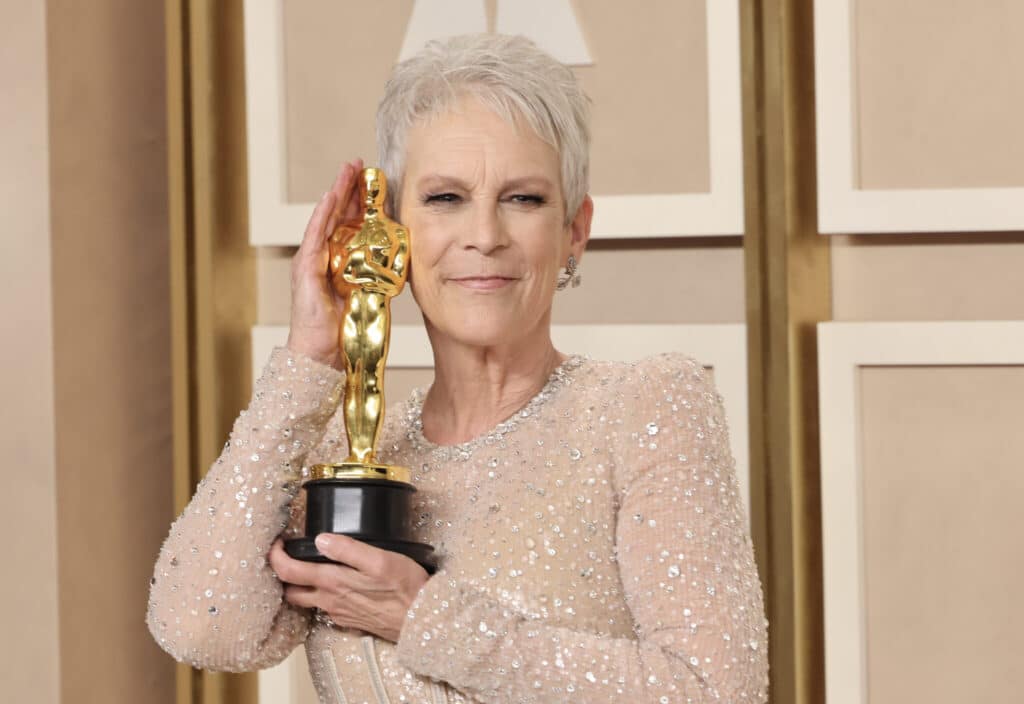
That aligns closely with Curtis’s broader public persona. Over the years, she has positioned herself less as a polished Hollywood figure and more as someone willing to speak plainly—even when that means disrupting expectations. Whether addressing beauty standards, aging, or industry pressure, she tends to reject the idea that public figures should always appear controlled or carefully filtered.
Her stance on cosmetic expectations is a good example. Curtis has been openly critical of the pressure placed on women in Hollywood to maintain a certain appearance, once describing how those standards can erase “natural human appearance” over time. Notably, she has also spoken candidly about her own experience with plastic surgery—admitting it was a decision she regretted. That kind of self-reflection adds weight to her critiques, making them less abstract and more personal.
Moments like her reaction to Janney fit into that larger pattern. They aren’t isolated incidents—they’re expressions of a consistent approach: direct, unscripted, and often deliberately unpolished.
There’s also a generational element to consider. Curtis belongs to a cohort of actors who built careers before the current era of constant digital scrutiny. That background may contribute to her comfort with spontaneity. Where some public figures might pause to consider how a comment will be clipped, shared, and interpreted, Curtis often speaks first and lets the interpretation follow.
At the same time, the context matters. The exchange worked because it was clearly mutual. Janney’s response—and her decision to share the moment—signaled that the comment was received exactly as intended. Without that mutual understanding, the same words could have landed very differently.
In the end, the moment didn’t become news because of the language itself. It became news because it captured something increasingly rare in public-facing spaces: an interaction that felt uncalculated.
Not perfectly polished. Not strategically framed.
Just human.
More From Daily Positive
 At dinner, my mom’s new husband turned me into the joke of the table, mocking me while everyone laughed and my own mother told me to “stop making a scene.”
 I found this in my girlfriend’s bathroom. We’ve been looking at it for an hour now and still can’t figure out what it is.
 My 12-Year-Old Daughter Spent All the Money She Had Saved to Buy New Sneakers for a Boy in Her Class – The Next Day, the School Principal Urgently Called Me to School
 My Ex-Husband Left Me at the Hospital the Day Our Son Was Born – 25 Years Later, He Couldn't Believe His Eyes
 The first things that will happen to Melania if Donald Trump dies in office
 I Sold My Long Hair to Buy My Daughter's $500 Dream Prom Gown – What Happened When She Walked Onto the Stage a Week Later Left Me Shaking