It topped the country chart and climbed all the way to No. 2 on the pop chart, helping prove that country music could compete in the mainstream without losing its emotional core.
For Reeves, the success felt almost tailor-made.
Nicknamed “Gentleman Jim,” he had built his reputation on a voice that was calm, controlled, and remarkably warm.
He didn’t need to shout.
He didn’t overplay heartbreak.
Instead, he leaned into the microphone and let the emotion sit quietly inside every line.
That restrained style became one of the signatures of the emerging Nashville Sound, a smoother, more sophisticated approach that blended country music with pop influences.
Reeves was one of the singers who helped bring that sound to a much wider audience.
His journey to that point had been anything but conventional.
Born in Texas, Reeves spent time pursuing baseball before injuries changed the direction of his life.
He later worked in radio, including as an announcer, before his recording career took off.
By the early 1950s, he had begun scoring country hits, eventually signing with RCA and becoming a major Nashville star.
Then came “He’ll Have to Go.”
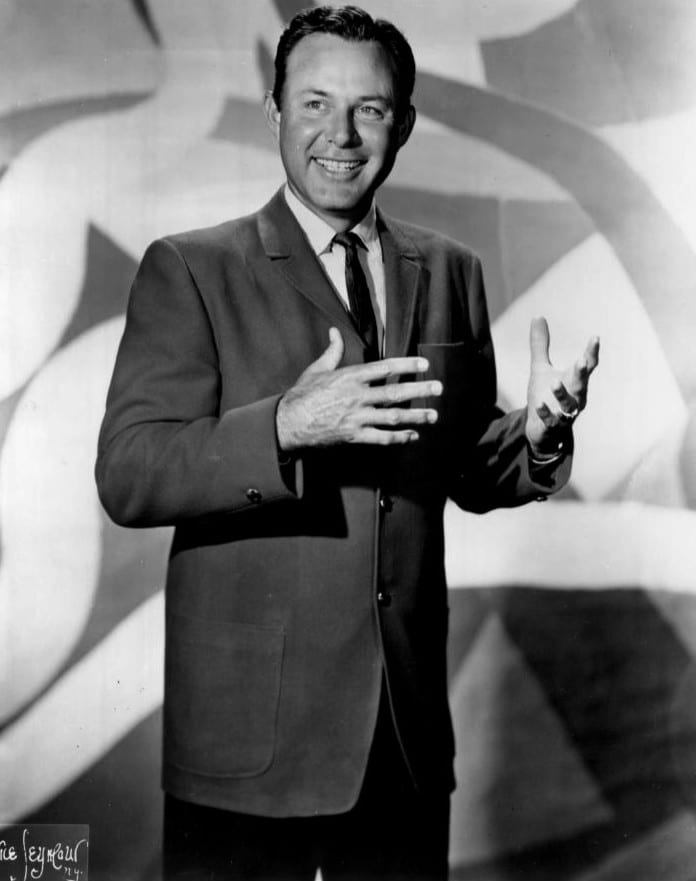
The song was written by Joe and Audrey Allison, and its conversational setup helped make it instantly memorable.
The lyric places the listener inside an intimate telephone conversation, with a man trying to convince the woman he loves to make a choice between him and another man.
That sense of immediacy became part of the song’s appeal.
Instead of sounding like a grand theatrical heartbreak number, it felt private.
Almost as though the listener had accidentally overheard a conversation they were never meant to hear.
Reeves’ delivery made that atmosphere even stronger.
He sang in a low, controlled register, allowing the spaces between the words to carry almost as much emotion as the lyrics themselves.
Producer Chet Atkins was central to the polished RCA sound Reeves developed during this era, and “He’ll Have to Go” became one of the clearest examples of the Nashville Sound reaching beyond the country market.
The arrangement did not overwhelm Reeves’ voice.
Instead, everything seemed designed to bring the listener closer.
That intimacy was important.
The song was about jealousy, longing, uncertainty, and the possibility of losing someone.
But Reeves never sounded desperate.
That was part of the magic.
He sounded composed even while singing about emotional turmoil.
The contrast gave the record an unusual power.
The public responded immediately.
“He’ll Have to Go” became a million-selling hit, reached the top of the country chart, and crossed over to No. 2 on the pop chart.
For a country record at the dawn of the 1960s, that crossover success was enormous.
It also strengthened Reeves’ reputation as an artist who could move comfortably between audiences.
He was unquestionably a country singer.
But listeners who rarely bought country records could still connect with him.
His voice was polished enough for pop radio.
His emotional storytelling remained rooted in country music.
That combination helped make him an international star.
Reeves had already toured Europe before the song became his signature hit, and his popularity later expanded to places including South Africa, England, Ireland, and other parts of Europe.
The success of “He’ll Have to Go” also became part of a much larger shift taking place in Nashville.
During the late 1950s and early 1960s, producers and artists were experimenting with ways to broaden country music’s appeal.
Traditional arrangements were increasingly mixed with smoother vocals and pop-oriented production.
Reeves became one of the most important voices associated with that movement.
His earlier hit “Four Walls” had already demonstrated how effective his softer vocal approach could be.
“He’ll Have to Go” pushed that formula even further.
The song did more than generate impressive chart numbers.
It became inseparable from Reeves himself.
Decades later, mentioning his name still brings the recording immediately to mind for many listeners.
That kind of connection is rare.
Plenty of singers have hits.
Far fewer record a song that becomes part of their identity.
Other artists would go on to interpret “He’ll Have to Go,” further demonstrating how adaptable the composition was.
But Reeves’ version remained the standard against which later performances were inevitably compared.
His voice gave the song a particular combination of elegance and vulnerability that was difficult to reproduce.
Then, just a few years after reaching that extraordinary level of success, tragedy struck.
On July 31, 1964, Reeves died in a plane crash.
He was only 40 years old.
The loss abruptly ended one of country music’s most distinctive careers.
But remarkably, Reeves’ commercial story did not end with his death.
His recordings continued selling.
New releases continued reaching the charts.
His popularity endured internationally.
In 1967, he was inducted into the Country Music Hall of Fame, just three years after his death.
That longevity says a great deal about what made Reeves different.
His music was tied to a particular era, yet it never felt trapped inside it.
The production was polished.
The arrangements were sophisticated.
But the emotions were simple and recognizable.
Longing.
Jealousy.
Love.
Loss.
Those feelings do not age.
Neither does a great voice.
More than six decades after “He’ll Have to Go” became a massive crossover hit, Reeves’ recording still sounds remarkably controlled and intimate.
There is no unnecessary drama.
No vocal showboating.
Just a singer, a melody, and a heartbreak delivered with extraordinary restraint.
That may be why the song has survived so well.
It helped define the Nashville Sound.
It helped push country music further into the pop mainstream.
And it helped transform Jim Reeves from an established country singer into one of the genre’s enduring legends.
For many fans, “He’ll Have to Go” is more than an old record.
It is the sound of an era.
A reminder of the moment when one soft-spoken Texas singer proved that sometimes the quietest voice in the room can be the one nobody forgets.
