Religious leaders condemned revealing swimsuits.
Governments banned them.
Police enforced beach dress codes.
And yet women continued wearing them.
Long before the bikini appeared, bathing clothes looked very different from what people wear today.
At the beginning of the twentieth century, swimsuits were often bulky, heavy, full-body garments made from materials such as wool.
They were designed less for style or comfort than for modesty.
In many places, showing too much skin at the beach was considered inappropriate.
Some American beaches enforced surprisingly strict rules.
At Chicago’s Clarendon Beach, tailors were reportedly available to make immediate adjustments to swimsuits officials considered too revealing.
Other communities had their own restrictions.
Coney Island, for example, banned bathing socks in 1915 if they exposed what authorities described as “dimpled knees.”
In Washington, D.C., beach officials were even known to use tape measures to determine whether swimmers were showing too much skin.
The expectation was clear.
Beachwear was supposed to cover the body.

Then women began challenging those standards.
One of the most famous early figures was Australian swimmer Annette Kellerman.
In 1907, Kellerman wore a one-piece swimsuit that exposed her arms, legs, and neck rather than using the heavy pantaloons and layered bathing outfits common at the time.
By today’s standards, the suit would hardly seem shocking.
At the time, however, it was considered daring.
Kellerman later said she had been arrested for wearing the outfit, although official documentation confirming that specific arrest has not been found.
Whether or not the exact story happened as later remembered, the controversy surrounding her swimwear was very real.
Kellerman became widely known for challenging old ideas about what women should wear while swimming.
Her practical one-piece designs grew popular enough that she eventually launched her own swimwear line.
The so-called “Annette Kellermans” became an important step toward modern women’s bathing suits.
By the 1920s, changing attitudes were becoming more obvious.
The flapper era was already transforming fashion, and those changes eventually reached the beach.
Some women openly protested traditional bathing costumes, arguing that swimsuits should actually allow people to swim comfortably.
A California group sometimes remembered as the “skirts be hanged girls” pushed back against restrictive bathing skirts and supported more functional swimwear.
Gradually, swimsuits became more fitted.
Hemlines became shorter.
Women gained greater freedom of movement.
But the biggest controversy was still ahead.
In 1946, French engineer Louis Réard introduced the bikini.
The design exposed the navel and considerably more skin than most people were accustomed to seeing in public.
Even its name captured attention.
Only days earlier, the United States had conducted a highly publicized nuclear test at Bikini Atoll in the Pacific.
Réard never left a definitive explanation of the name, but it has often been interpreted as a reference to the explosive reaction he expected his swimsuit to create.
He was right about the reaction.
The bikini immediately became controversial.
Many beaches in the United States refused to allow it.
Restrictions appeared in parts of Europe as well.

Religious and political groups criticized it as immoral, indecent, or culturally dangerous.
Pope Pius XII was reported to have condemned the bikini as sinful, while countries including Belgium, Italy, Portugal, and Spain imposed restrictions or bans at different points.
In 1952, Australian model Ann Ferguson was reportedly asked to leave Surfers Paradise after appearing in a bikini designed by Paula Stafford.
Stories like hers became part of a much larger argument over who should decide what women were permitted to wear in public.
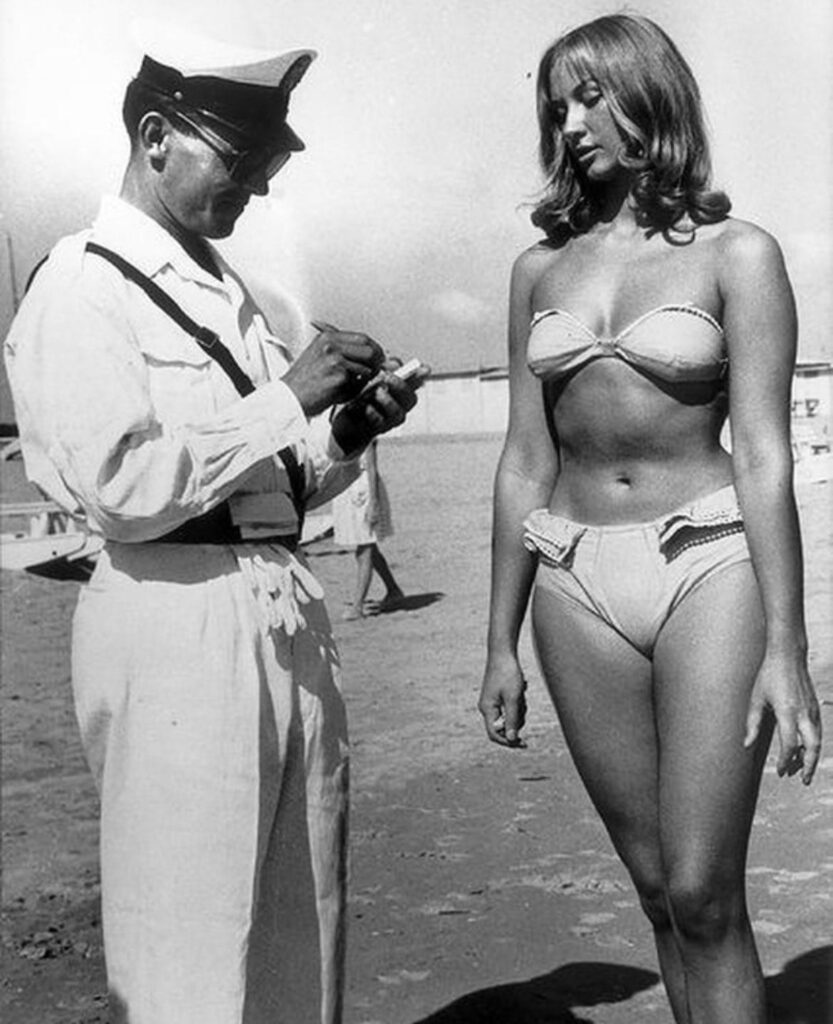
One photograph from that era has become especially famous.
The black-and-white picture shows a young woman wearing a bikini while a man in a white uniform stands beside her on a beach.
For years, social media posts have claimed the photograph was taken in Rimini, Italy, in 1957 and shows a police officer writing the woman a ticket simply because she wore a bikini.
The image has been shared thousands of times as proof of how strict beach rules once were.
But the photograph’s real story is not entirely clear.
The image itself appears authentic, but there is no definitive evidence proving that the woman was being fined specifically for her swimsuit.
Some researchers have suggested the photograph could have been staged.
Others believe the uniformed man may have been speaking to her for a completely different reason.
Still, the broader historical context behind the viral image is genuine.
Italy did have laws regulating swimwear.
Gianluca Braschi of the State Archives of Rimini confirmed that a 1932 law prohibited people from bathing in public view while completely nude or wearing what authorities classified as “indecent swimwear.”
The law technically remained on the books for decades, although enforcement varied.
So even if the exact circumstances behind the famous photograph remain uncertain, the tension it represents was very real.
The bikini could genuinely get someone removed from a beach or confronted by authorities.
By the 1960s, however, attitudes were shifting rapidly.
Hollywood played a major role.
Film censorship rules had previously limited how much skin actresses could show on screen.
Under the Motion Picture Production Code, commonly called the Hays Code, two-piece swimsuits could appear, but exposing the navel was generally prohibited.
Religious pressure groups also encouraged filmmakers to avoid bikinis.
Then actresses began changing the image of the swimsuit entirely.
Brigitte Bardot became one of the most important figures in the bikini’s rise.
Her appearance in *The Girl in the Bikini* helped transform the garment from scandalous beachwear into something glamorous and cinematic.
Bardot’s confidence became as important as the swimsuit itself.
She helped associate the bikini with youth, freedom, glamour, and rebellion.
The garment no longer appeared merely provocative.
It became fashionable.
Another unforgettable moment arrived in 1962.
Ursula Andress emerged from the sea in *Dr. No* wearing a white bikini with a knife strapped to her hip.
The scene became one of the most recognizable images in James Bond history.
Andress appeared confident, strong, and completely comfortable in what she was wearing.
That image helped push the bikini even further into mainstream popular culture.
Marilyn Monroe and other major stars also helped reshape attitudes toward swimwear and body confidence.
By the 1970s, the transformation was unmistakable.
The bikini was no longer a rare symbol of rebellion.
It was everywhere.
Designs became smaller.
String bikinis grew popular.
Thong-style swimwear appeared.
Men’s swim trunks also became shorter and more fitted.
The heavily covered bathing costumes of the early twentieth century suddenly seemed like relics from another world.
Today, swimwear is defined far more by choice.
Some people prefer full-coverage one-piece suits.
Others wear bikinis.
Some choose modest swimwear for cultural, religious, or personal reasons.
Others prefer extremely minimal designs.
The most important difference is that the conversation has shifted away from enforcing one universal standard.
Modern swimwear culture increasingly emphasizes comfort, confidence, individuality, and personal preference.
People of different body types, ages, and backgrounds now appear in styles that previous generations might never have imagined seeing on a public beach.
That does not mean debates about modesty have disappeared.
They probably never will.
But the history of swimwear shows how dramatically social standards can change.
A century ago, authorities could measure the length of a swimsuit.
A woman exposing her legs could cause scandal.
A bikini might get someone removed from a beach.
Today, the same garment is ordinary summer clothing.
What began as a battle over how much skin could be shown gradually became part of a much larger conversation about independence and self-expression.
The bikini’s history is therefore about much more than fashion.
It reflects changing ideas about women, bodies, public morality, personal freedom, and who gets to decide what is considered acceptable.
So the next time someone puts on a swimsuit and heads to the beach without thinking twice, it is worth remembering how much controversy once surrounded that simple choice.
What looks ordinary today was once revolutionary.
