He said the family lived without the sense of security children normally expect from home.
And according to Depp, the emotional damage could be even harder to endure than the physical violence.
“The verbal abuse, the psychological abuse, was almost worse than the beatings.”
He explained that physical pain was something he eventually learned to tolerate, while the psychological wounds stayed with him in a different way.
One of the people Depp watched closely during those years was his father, John Depp Sr.
The actor recalled seeing his mother direct terrible verbal attacks at him while his father remained remarkably restrained.
“When my mother would go off on a tangent toward my father… he, amazingly, remained very stoic.”
Depp has said his father never retaliated physically against his mother.
As a young boy, that confused him.
He wondered why his father tolerated the treatment and why he did not simply leave.
Only later did Depp begin seeing his father’s behavior differently.
“To me, as a five-year-old boy, I kept wondering, why does he take it? How does he take this? And why doesn’t he leave her?”
Eventually, his parents’ marriage ended.
Depp has spoken about initially viewing his father’s departure as abandonment before coming to understand that his father had reached a point where he could no longer remain in the relationship.
The situation at home became even more difficult afterward.
Depp has described his mother falling into severe depression and attempting suicide by taking numerous pills.
He also testified that his own exposure to drugs began disturbingly early.
He has said he started taking his mother’s “nerve pills” when he was around 11, began smoking at 12, and experimented with drugs during his teenage years.
Years later, Depp would connect those early experiences with his attempts to escape the instability surrounding him.
During his highly publicized 2022 defamation trial involving former wife Amber Heard, Depp described beginning to use drugs at a very young age while living in what he characterized as an unstable and unsafe home.
He said substances became a way of numbing emotional pain.
Yet when speaking about his mother years later, Depp offered a complicated reflection.
Despite describing the childhood abuse in painful detail, he said the experience taught him one valuable lesson.
“I thank her for that.”
But his meaning was not that he approved of what happened.
Rather, Depp said his mother taught him exactly what he did not want to repeat as a parent.
“She taught me how not to raise kids. Just do the exact opposite of what she did.”
That philosophy became especially important after Depp became a father himself.
Long before that, however, acting was not even his original plan.
Music was.
After dropping out of high school, Depp played guitar and eventually moved to Los Angeles with his band, The Kids.
He later described his acting career as something that happened almost by accident.
His friend Nicolas Cage encouraged him to meet with an agent and consider auditions.
That unexpected suggestion led to a role in Wes Craven’s 1984 horror classic *A Nightmare on Elm Street*.
From there, Depp’s career began moving quickly.
His role in the television series *21 Jump Street* transformed him into a teenage heartthrob.
But Depp became increasingly uncomfortable with the conventional image that came with that fame.
Instead of pursuing straightforward leading-man roles, he gravitated toward unusual characters and unconventional films.
That decision helped define his career.
There was *Edward Scissorhands*.
*Ed Wood*.
*Donnie Brasco*.
*Fear and Loathing in Las Vegas*.
*Sleepy Hollow*.
And then came the character that would make him an international phenomenon.
Captain Jack Sparrow.
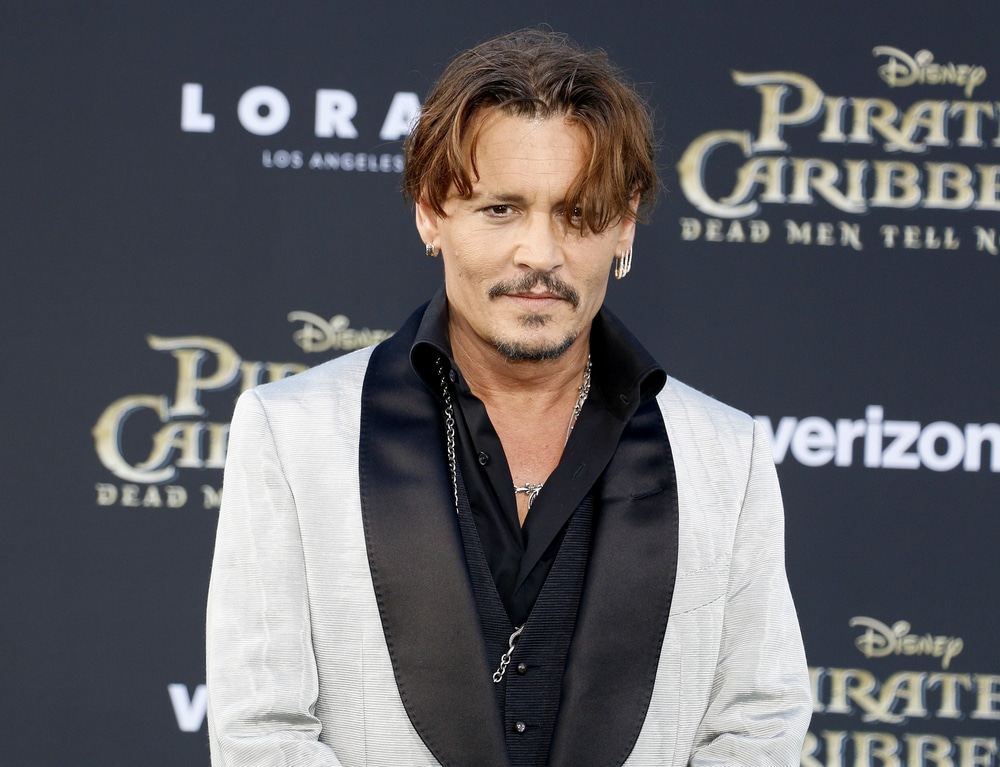
When *Pirates of the Caribbean: The Curse of the Black Pearl* arrived in 2003, Depp’s eccentric, unpredictable pirate became the centerpiece of a franchise that would eventually span multiple films.
His performance as Jack Sparrow earned him his first Academy Award nomination for Best Actor. Depp later received two more Oscar nominations, for *Finding Neverland* and *Sweeney Todd: The Demon Barber of Fleet Street*.
The strange little boy from an unstable home had become one of the biggest movie stars in the world.
His personal life was receiving enormous attention too.
Depp’s first marriage, to makeup artist Lori Anne Allison, lasted from 1983 to 1985.
He later had several highly publicized relationships, including romances with Jennifer Grey and Winona Ryder.
Eventually, he began a long relationship with French singer and actress Vanessa Paradis.
The pair were together from 1998 until 2012 and had two children, Lily-Rose and Jack.
Becoming a father made Depp think deeply about his own childhood.
He has said that when Paradis became pregnant, he already knew one thing clearly: he wanted his children’s home to feel completely different from the one he remembered.
“When my girl, Vanessa, got pregnant, I knew exactly how to raise children, which was to do the opposite of what they did — of what Betty Sue did.”
He described trying not to rely on shouting, threats, or fear.
Instead, he said he preferred explaining consequences and giving his children choices whenever possible.
His goal, he testified, was to communicate rather than intimidate.
Whatever controversies later surrounded Depp’s adult life, he has repeatedly connected that parenting philosophy to his determination not to recreate the atmosphere he experienced as a child.
After his relationship with Paradis ended, Depp became involved with actress Amber Heard.
They married in 2015.
The marriage ended the following year and eventually produced years of bitter legal conflict in both Britain and the United States.
The legal history is more complicated than simply saying one side “won.”
In 2020, Depp lost a libel case in Britain against *The Sun* over its description of him as a “wife beater,” with the judge finding the newspaper’s characterization substantially true.
Two years later, a Virginia jury found that Heard had defamed Depp in a 2018 *Washington Post* op-ed and awarded him damages. The same jury also found Depp liable for defaming Heard through statements made by his attorney and awarded her damages on one counterclaim. The two later settled their remaining appeals.
The Virginia proceedings also brought extraordinary public attention to Depp’s childhood.
He testified at length about his family, his mother’s behavior, his father, and his early substance use.
Years later, he continued defending his decision to take the dispute to court.
Reflecting on the experience in 2025, Depp said he believed the accusations would never simply disappear if he remained silent.
For him, he said, the issue extended beyond his own reputation because his children and future generations of his family would have to live with what had been said publicly about him.
After years in which his personal life often overshadowed his films, Depp gradually returned to acting and directing.
He appeared in the French historical drama *Jeanne du Barry* and directed *Modì, Three Days on the Wing of Madness*.
And in November 2026, Depp returned to a major Hollywood studio release with *Ebenezer*, Ti West’s adaptation of Charles Dickens’ *A Christmas Carol*.
The film, released on November 13, features Depp as Ebenezer Scrooge alongside performers including Rupert Grint, Andrea Riseborough, Daisy Ridley, Tramell Tillman and Ian McKellen.
Another major project is also on the horizon.
Depp stars alongside Penélope Cruz and Madelyn Cline in the action thriller *Day Drinker*, continuing a professional reunion with Cruz after their previous work together.
And speculation about one role refuses to disappear.
Captain Jack Sparrow.
Depp recently said he would consider another *Pirates of the Caribbean* appearance under the right circumstances, particularly if longtime producer Jerry Bruckheimer were involved and the character could be given what Depp considers a more satisfying farewell.
“I want to send them off on a better note.”
He stopped short of officially confirming a return, meaning Jack Sparrow’s future remains uncertain.
For all of Depp’s professional success and controversy, however, one of the most revealing parts of his story remains the distance between the childhood he described and the life he eventually built.
He grew up saying he never knew when something might be thrown across the room.
He experienced instability, frequent moves, violence and substance use at an extraordinarily young age.
Then he became a musician.
An actor.
A teenage idol.
An unconventional leading man.
And eventually one of the most recognizable movie stars of his generation.
Fame did not erase what happened in that childhood home.
By Depp’s own account, those experiences followed him.
But they also shaped one of the promises he later made to himself as a father.
He could not change how he had been raised.
He could only decide whether to repeat it.
And as he once explained, his approach was remarkably simple:
Do the opposite.
