Elon Musk is no stranger to bold predictions — but his latest warning about artificial intelligence might be one of his most dramatic yet.
In a recent conversation on the Cheeky Pint podcast with Dwarkesh Patel, Musk argued that humanity is racing toward a hard physical limit. Not a software problem. Not an algorithm issue. A power problem.
According to Musk, Earth may have only months — not decades — to figure out how to power the explosive growth of AI before we hit a wall.
And his proposed solution? Move large-scale AI infrastructure into space.
Musk pointed out that while AI debates often center around ethics, safety, and regulation, the real bottleneck may be electricity. Massive data centers running advanced models consume extraordinary amounts of energy, and that demand is growing rapidly.
“All of the United States currently uses only about half a terawatt of power on average,” Musk said. “Imagine trying to build enough power plants to double that. People don’t realise how hard that actually is.”
That’s the core of his argument: scaling power generation fast enough to support AI could be far more difficult than scaling AI itself.
He predicts that within “36 months or less — maybe 30 months,” space will become the cheapest and most practical location to deploy large AI systems.
“Less than 36 months, mark my words,” he emphasized.
Musk believes the economics will shift quickly. Solar energy in orbit, he argues, offers major advantages. Panels in space receive near-constant sunlight, unaffected by clouds, nighttime cycles, or atmospheric interference. According to him, they can generate significantly more energy than ground-based systems — potentially up to five times as much.
On Earth, renewable energy requires expensive battery storage to compensate for variability. In orbit, that problem largely disappears.
“Solar cells are already very cheap, around 25 to 30 cents a watt in China,” Musk noted. “Put them in space and it’s effectively 10 times cheaper because you don’t need batteries.”
The idea isn’t entirely theoretical. Reports indicate Musk has filed plans with U.S. regulators to potentially deploy up to one million satellites in the future — a staggering number — to support solar-powered data centers in orbit. For context, roughly 15,000 satellites currently orbit Earth, including over 9,600 active Starlink satellites operated by SpaceX.
A million-satellite AI infrastructure network would be unprecedented.
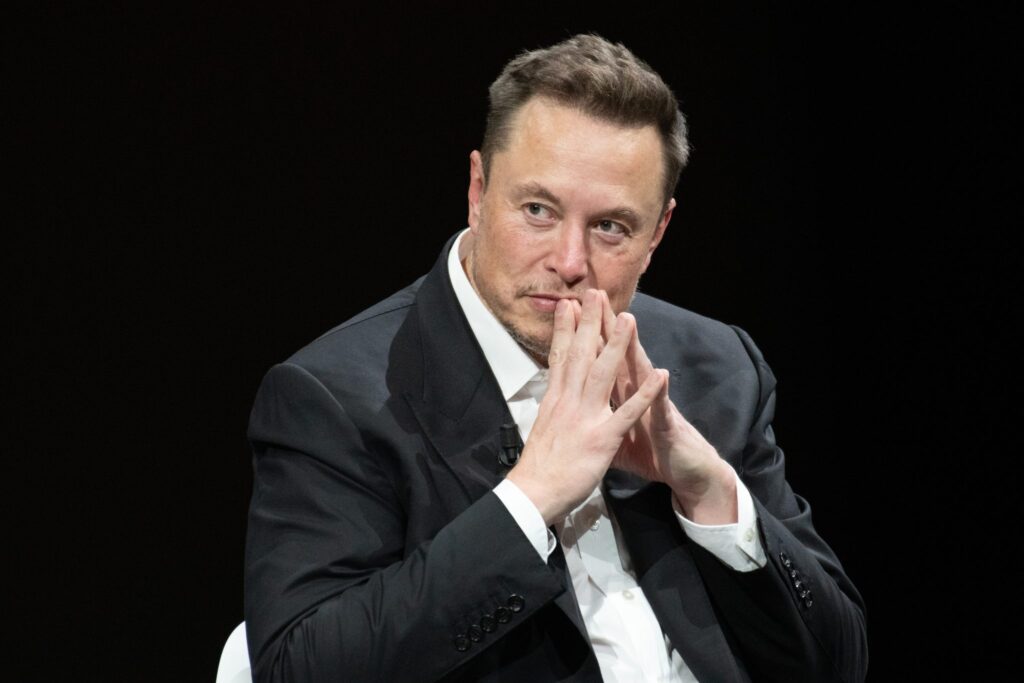
Musk frames this not just as a business opportunity but as an existential necessity. In his view, Earth’s energy constraints could leave humanity technologically stranded if AI development continues accelerating without sufficient power capacity.
“You start thinking in terms of what percentage of the sun’s power you’re harnessing,” he said. “Then you realize you have to go to space. You can’t scale very much on Earth.”
It’s a dramatic vision — one that blends solar economics, space engineering, and AI expansion into a single future roadmap.
At the same time, experts have raised broader questions. Large-scale orbital infrastructure could introduce its own risks: space debris, regulatory complexity, geopolitical tension, and environmental consequences. There’s also debate over whether terrestrial energy innovation — such as advanced nuclear, improved grid systems, or next-generation storage — might solve AI’s energy needs without moving off-planet.
Still, Musk’s comments tap into a very real issue: AI’s energy footprint is growing fast. Data centers already account for a meaningful share of global electricity demand, and governments worldwide are grappling with how to balance digital expansion with climate goals.
Is space-based AI the inevitable next step? Or is this another example of Musk thinking several leaps ahead — perhaps too far ahead — of current infrastructure and economics?
Whatever one’s stance, his warning underscores a larger truth: AI’s future isn’t just about code. It’s about physics, power, and planetary limits.
And if Musk is right, the next frontier for artificial intelligence might not be Silicon Valley — but orbit.
More From Daily Positive
 “I own this house, son, and you just violated the morality clause.” — The wife’s mysterious father appeared to remind the arrogant CEO that his lifestyle depended on the woman he had just betrayed.
 People are only just learning what the tiny hole in nail clippers is actually for
 In a significant breakthrough, Arizona law enforcement office
 My DIL Kicked Me Into a Shelter While My Son Was Away on a Business Trip – But She Never Expected Him to Find Out
 Ex-LA County worker arrested in Nancy Guthrie case
 With heavy hearts, we report the tragic news about this multi-talented actor