President Donald Trump congratulated the U.S. men’s Olympic hockey team after their dramatic gold medal victory over Canada on Sunday. During a celebratory phone call with the players, however, a comment he made about the women’s team — who had also just secured gold — quickly became a topic of debate online.
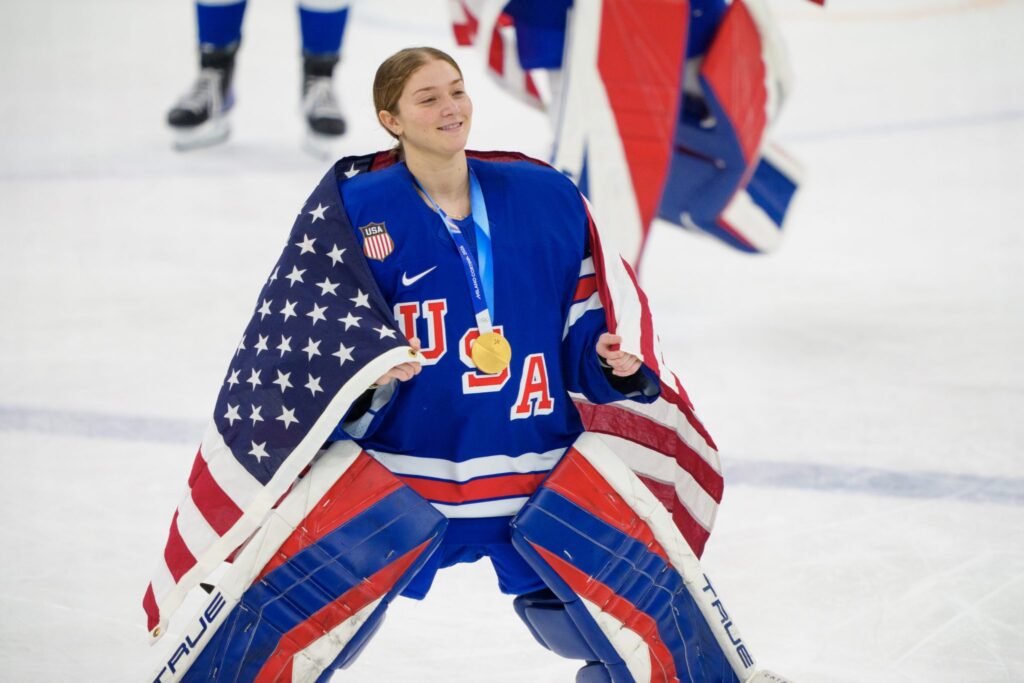
The U.S. women’s Olympic hockey team, fresh off their own overtime win against Canada, later confirmed they would not attend a White House invitation tied to the upcoming State of the Union address in Washington, D.C. Their decision, paired with Trump’s remark, fueled strong reactions across social media.
Trump Praises Men’s Team — Then Jokes About Women’s Invitation
Following the men’s championship victory, President Trump spoke to the team by phone, applauding their performance.
“Unbelievable. You were all unbelievable! That team is pretty good you played.”
The tone shifted when he referenced the women’s team, who had defeated Canada 2–1 in overtime the previous day to claim gold at the Winter Olympics in Milan.
“I must tell you, we’re going to have to bring the women’s team. You do know that. I do believe I probably would be impeached [if the women’s team wasn’t invited].”
Some listeners interpreted the remark as lighthearted humor. Others viewed it as dismissive or unnecessary, especially given the women’s achievement on the same global stage.
Women’s Team Declines White House Invitation
Shortly after the phone call made headlines, the U.S. women’s hockey team released a public statement addressing the invitation.
“We are sincerely grateful for the invitation extended to our gold medal–winning U.S. Women’s Hockey Team and deeply appreciate the recognition of their extraordinary achievement.”
The statement continued by explaining that previously arranged commitments prevented the athletes from attending.
“Due to the timing and previously scheduled academic and professional commitments following the Games, the athletes are unable to participate. They were honored to be included and are grateful for the acknowledgment.”
The team’s response was formal and measured, emphasizing appreciation while clarifying scheduling conflicts. Still, the decision not to attend quickly became a lightning rod for online discussion.
Social Media Reaction Divided
Within hours, the story was trending across platforms. Supporters of the women’s team praised what they saw as independence and principle.
One user wrote, “That’s how you do it. These ladies are the real patriots.”
Another commented, “I am so proud of the women’s US hockey team for standing up for what is right and just. They have great backbone and convictions.”
Some critics of the president suggested the remark contributed to the team’s choice. A third social media user quipped, “The idea of spending time w/ him does not have the universal appeal he thinks it does.”
However, not everyone agreed with that perspective. Other commenters argued that the invitation represented a rare honor, regardless of politics.
One post read: “If the PRESIDENT personally invite’s you to the STATE OF THE UNION then guess what??? YOU GO!”
Another defended Trump’s tone, saying, “He was obviously being humorous about the women’s team. Geez people, lighten up! And if the women’s team declines, then that’s their choice.”
Some critics went further, expressing frustration over what they perceived as disrespect toward the presidency.
A Familiar Intersection of Sports and Politics
Moments like this highlight the increasingly blurred line between athletics and political discourse. Celebrations at the White House have long been considered symbolic recognition of national achievement. Yet in recent years, invitations have sometimes sparked broader debates about personal beliefs, public image, and civic tradition.
Both the men’s and women’s teams achieved remarkable success on the ice, defeating Canada in closely contested overtime matchups to secure Olympic gold. Their performances were widely celebrated across the country.
At the same time, the public response to the White House invitation underscores how even celebratory moments can take on deeper political meaning in today’s climate.
The women’s team cited scheduling conflicts as the reason for declining. Supporters and critics alike have interpreted the move through their own lenses.
What remains clear is that Team USA’s victories in Milan will be remembered for their athletic excellence — even as the conversation surrounding the invitation continues.
More From Daily Positive
 Savannah Guthrie makes chilling confession that mom Nancy may be dead
 AI reveals who would win the US presidential election if Trump ran against Obama in 2028
 Ana was cleaning the refrigerator when, suddenly, her husband appeared in the kitchen doorway.
 Men born in these months are the most faithful husbands — Is your man on this list?
 You won’t be fooled again after seeing this
 I Thought My Husband Died — Then Three Years Later He Moved Into the Apartment Next Door With Another Woman and a Child