Just moments after publicly criticizing Pope Leo XIV, Donald Trump ignited a new wave of controversy—this time not through words, but through imagery.
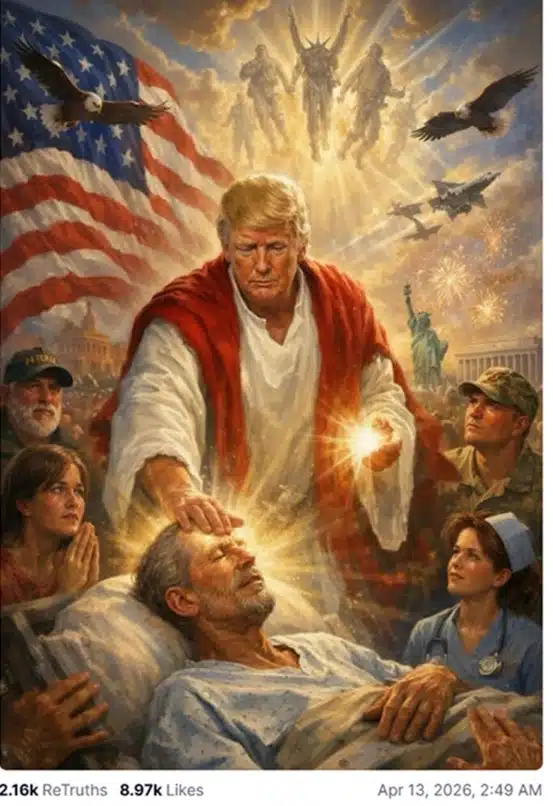
On Sunday, Trump shared an AI-generated illustration on his platform, Truth Social. The image depicted him in flowing white and red robes, with glowing hands placed on the forehead of a man lying in a hospital bed. The composition closely resembled traditional depictions of Jesus performing acts of healing.
Notably, the post appeared without any caption, adding to the ambiguity surrounding its intent.
Timing Intensifies Reaction
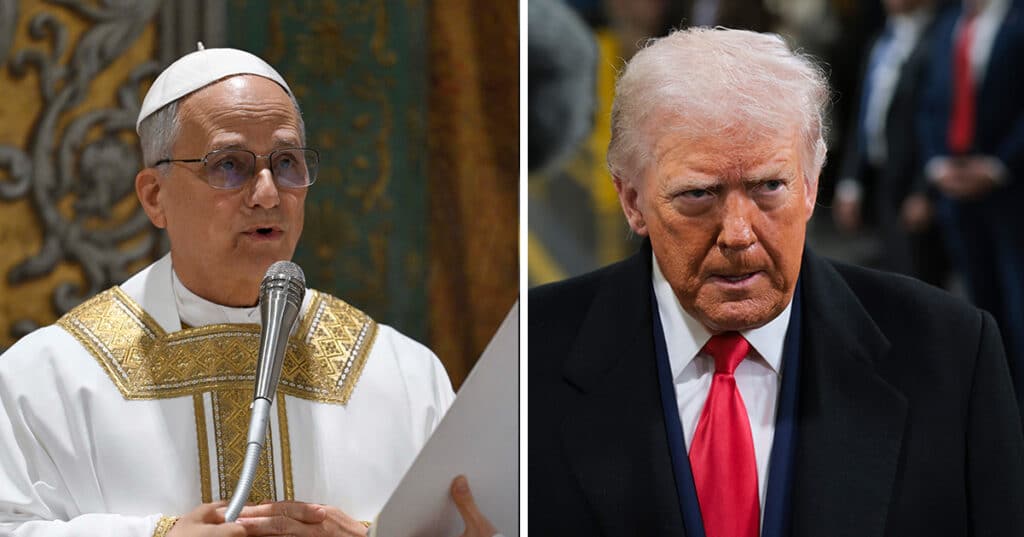
The image did not exist in isolation. It followed shortly after Trump criticized Pope Leo XIV, describing him as “weak on crime” and “terrible for foreign policy.”
The pope—described as the first American-born leader of the Catholic Church in this context—had recently spoken out against escalating tensions in the Middle East, particularly the U.S.-Israeli conflict involving Iran. He condemned what he called “absurd and inhuman violence,” positioning himself firmly on moral and humanitarian grounds.
In response to Trump’s remarks, he stated:
“I have no fear of the Trump administration, or speaking out loudly of the message of the Gospel.”
The juxtaposition of political criticism and symbolic religious imagery amplified the reaction online.
A Highly Symbolic Visual
The AI-generated image itself is layered with visual cues that extend beyond religion.
Alongside Trump and the patient, figures appear to watch in awe: a doctor, a praying woman, and a uniformed soldier. In the background, iconic American symbols—including the Statue of Liberty, a structure resembling the Lincoln Memorial, fighter jets, and fireworks—create a blend of national identity and spiritual authority.
This combination has led many to interpret the image not just as artistic expression, but as a deliberate merging of political leadership with symbolic, almost messianic imagery.
Divided Public Response
Reactions across social media were immediate and sharply divided.
Critics described the post as inappropriate and provocative, particularly given its religious undertones. Some viewed it as crossing a line by invoking imagery traditionally associated with faith and sacred figures.
Supporters, on the other hand, interpreted the post differently—some seeing it as satire, others as a bold or symbolic statement aligned with Trump’s long-standing communication style.
This divide reflects a broader pattern in how Trump’s messaging is received: the same content often generates entirely opposing interpretations depending on perspective.
A Pattern of Provocative Imagery
This is not the first time Trump has shared AI-generated or stylized imagery of himself in symbolic roles.
In previous instances, he has posted visuals portraying himself as a monarch, as well as imagery inspired by cinematic or historical references. Following the death of Pope Francis, he also shared an image depicting himself in papal attire—another moment that drew criticism, particularly from religious communities.
These recurring posts suggest a communication strategy that blends humor, provocation, and visual storytelling—often blurring the line between satire and serious messaging.
Where Is the Line?
At the center of the debate is a broader question: how should political figures use symbolic imagery, especially when it intersects with religion?
For some, such posts are simply modern forms of expression in a digital age dominated by memes and AI-generated content. For others, they raise concerns about tone, respect, and the potential impact on public discourse.
What remains clear is that Trump continues to command attention—not only through policy or rhetoric, but through the imagery he chooses to share.
And with each new post, the same underlying question persists:
At what point does provocative messaging shift from strategy into something more consequential?
