I never planned on bringing a stranger home, let alone someone soaked to the bone under a flickering streetlamp. But that’s what happened.
It was one of those nights where the rain clings to your skin, the city feels extra lonely, and you start wondering what it’s all for. I spotted her on the corner near the old bakery—an older woman, hunched against the cold, motionless in the downpour. No begging sign. No pleas for help. Just… stillness.
Her calm unsettled me.
“Hey,” I called out, hesitating. “You okay?”
She lifted her head slowly. Her face was aged by time and struggle, but her eyes—sharp, steady—were something else. They reminded me of my mom’s. And I guess that was enough.
“I’m tired of shelters,” she said. “Tired of being moved like furniture.”
“You could stay in my garage,” I blurted, before I even understood why.
She blinked at me like I’d spoken another language. “Your garage?”
“There’s a room in there. Small, dusty, but it’s got plumbing and a bed. I’ll bring you food. Blankets. It’s yours if you want it.”
She stared for a second, then gave a quiet laugh. “I’ve got nothing left to lose. Alright. I’m Dorothy.”
“Henry,” I said. “Come on, it’s around the corner.”
I drove her home that night. Fed her takeout. Locked the main house, not out of fear—just out of habit. She didn’t ask for more.
The next day, I visited Sandra, my girlfriend. When I told her what I’d done, her face pinched into something between disbelief and concern.
“You let a stranger live in your garage?” she whispered over grilled sandwiches. “What if she’s dangerous?”
“She’s not,” I said. “She needed help. I gave it.”
Sandra wasn’t convinced. But she let it go, on the condition she’d meet Dorothy the next day.
I didn’t check on Dorothy again that night. The garage light was on, and the food basket I’d left was gone. She was quiet. Respectful. That was enough for me.
But Sunday morning, something felt off. Not wrong—just… different.
When I stepped outside and peeked through the garage window, I stopped breathing.
It wasn’t a garage anymore.
The space had been transformed—cleaned, swept, curated like a page out of an interior design magazine for misfits. My mom’s books were on a shelf. A plant sat cheerfully on a crate-turned-table. A throw blanket neatly covered the old couch. My mother’s favorite lamp glowed warmly in the corner.
And in the middle of it all, sat Dorothy.
Her hair was brushed, her dress—vintage and familiar—was one I hadn’t seen since my mom’s funeral. She looked calm. Composed. Almost… regal.
I opened the door, stunned. “What is this?”
Dorothy smiled, barely glancing up from the book she was reading.
“I cleaned. It’s nice to feel human again.”
“You look… different.”
She closed the book gently. “You want to know who I am?”
I nodded.
So she told me.
Once, she was a professor of literature. A lover of words and history, who lived a full life with her husband, Jack, and their teenage son, David. They were ordinary. Happy.
And then one night, during a simple outing for ice cream, everything fell apart.
A car. A panicked man. A gun. Two bullets. Two lives gone.
After that, she said, she stopped being Dorothy. She let her life fade around her, until there was nothing left.
She didn’t cry as she spoke. She didn’t need to. Her voice did all the unraveling for her.
I stayed with her the whole evening, eating pasta and garlic bread in that little space she’d transformed into something sacred. And when Sandra came by to meet her, even she was floored.
“She’s incredible,” Sandra whispered. “Sharp. Kind. You were right.”
Dorothy never asked for anything. But I brought her more food. A coat. A heater. Eventually, a small fridge and stove. Months passed. She got a job at the local library. A year later, she moved into a tiny apartment of her own.
The day I visited her new place, she poured me tea, surrounded by books and soft light.
“You did it,” I said.
“We did,” she corrected gently. “You saw me when I didn’t want to be seen. And that saved me.”
It hit me then—she wasn’t just someone I helped. She was someone who reminded me what it meant to live again. To care. To connect.
Sometimes, helping someone else is the only way to help yourself. And kindness? It doesn’t disappear. It circles back, even when you least expect it.
And Dorothy? She’s family now.
The kind you choose. The kind that chooses you back.
Keep the Music Going
 My Aunt Slipped Grandma’s Diamond Ring Off Her Finger on Her Deathbed — Two Days After the Funeral, a Package Arrived That Made Her Turn Pale
 Entitled Woman Called Me, a 72-Year-Old Waitress, ‘Rude’ and Walked Out on a $112 Bill – I Showed Her She Picked the Wrong Grandma
 My Fiancée Shoved a 60-Year-Old Cleaning Lady Out of a Bridal Boutique Not Knowing She Was My Mother – My Last Words Came at the Altar Two Days Later
 When I Was 5, Police Told My Parents My Twin Had Died – 68 Years Later, I Met a Woman Who Looked Exactly Like Me
 Young woman puts both daughters inside the fir… See more
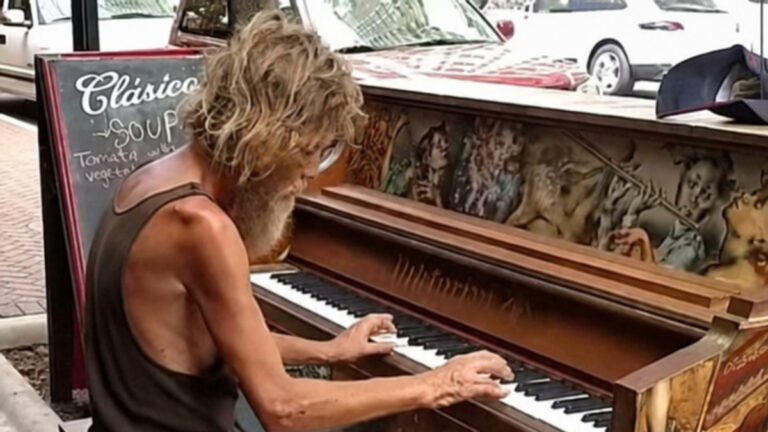 Homeless Man Leaves Passers-By Shocked With Hidden Piano Talents